Showing posts with label Kenya. Show all posts

January 05, 2011

Under the cloak: Creepy crawlies


Wood carvings might be the world's most ubiquitous souvenir. You can find "traditional local crafts" made of wood nearly anywhere with trees and tourists.

My collection of wooden geegaws from around the globe includes a Buddhist prayer wheel from Nepal, a foot-long manatee from Belize and infant-sized clogs from Brittany.

But the Masai woman from Kenya, pictured here, cured me of carvings and is the last one I will ever buy.


When we returned home from Africa I displayed the carving on the sideboard in our dining room alongside other souvenirs of our travels. One night while we were eating I glanced at the sideboard and noticed that the top of it seemed to be moving.

I got up to inspect and let out a scream that made Mike drop his fork. "Bugs! Bugs are crawling out of this carving!" The Masai woman was alive with tiny critters that were spilling from behind the piece of intact tree bark that had been shaped into a cloak that ran down her back. I picked her up and threw her into the kitchen sink while Mike ran a Pledge-dampened rag over the sideboard to collect the insects.

I ran hot water over the infested carving and watched scores of beasties fall out of it and disappear down the drain. Scalding and drowning the bugs was probably sufficient, but for good measure I ground them up in the garbage disposal. Then I took the piece outside and pried the bark cloak that housed the critters off with a butter knife.

I scrubbed the area that had been under the bark with a Brillo pad, then shot half a can of Raid ant killer all over the carving, steps I later repeated.

It took a few hours for the wet, Raid-infused carving to dry in the July sun, but I kept it outside on our concrete stoop for a few days, checking it often for signs of life.

When I was satisfied that my eradication methods had been successful I returned the cloak-less lady to her perch on the sideboard.

I do like her but admit to feeling a hint of the heebie jeebies when I look at her.

There's a world of wood carvings out there waiting for us tourists, suckers for traditional local crafts. You've been warned; some harbor stowaways.

Caveat emptor. And if you do buy, keep the Raid handy.

September 28, 2009

Carrion call


Carrion eaters is not a subject that flies across the radar screen of most people's daily lives, but on a recent day I encountered the subject of giant, flesh-eating birds not once, not twice, but three times (one of those times in the flesh).

In the morning Dana handed me her college application essay, the piece of work that will, if done well, convey to admissions officers something true and real about her that other components of her application may not.

Her essay is about our trip to Uganda and its effect on her life. It's beautiful, and I love it more with each reading. Near the beginning she makes a reference to the big birds that lurk in and circle over Kampala:

"There were differences between their world and mine: four-foot-tall marabou storks don’t rest on my neighbors’ satellite dishes, ubiquitous signs warning about the prevalence of AIDS don’t mark my Boston streets, whole families don’t navigate the city on a single, chugging motor scooter, and women don’t sit by the side of the road selling bananas and spreading sorghum out to dry..."

A few hours after Dana's essay had plucked Uganda memories from the back of my mind and put them up front, I sat down with a book, the 2002 edition of The Best American Travel Writing. I'd picked up the anthology the week before at a used book sale and was half-way through. The next story on tap was Edward Hoagland's "Visiting Norah," originally published in Worth magazine. I almost dropped the book when I read the first sentence:

"Two pairs of marabou storks, each of them five feet tall and battleship gray with a pink neck and a wattle pouch, proudly posing and croaking, were raising chicks in bulky nests in the flame trees that overlooked the swimming pool at the Fairway Hotel in Kampala, Uganda."

Where Dana's marabou storks stay benignly in their satellite dishes, Hoagland's fowl are ready to swoop down and feed:

"... marabou storks... are carrion feeders and offal scavengers, similar to but larger than the most no-nonsense vulture, and in famine territory they of course will eat children who drop by the wayside. In the chaos of modern Africa, they have moved from the veldt and forests into the cities, wherever garbage and death and anarchy erupt. They are tolerated because, as they stalk around, gobbling refuse, rodents, fruit rinds, rotting vomit, dog carcasses... with their thick, scary beaks, they fend off disease. But when I saw them roosting in the downtown parks... as if watching for any homeless person who might be staggering or bleeding, they looked like undertakers to me."

They are hideous and huge, and they are everywhere in Kampala. It took me and Dana about a day to get used to their wheeling, squawking, hulking forms as just another routine piece of the urban puzzle.

So, it's lunchtime in my little Boston 'burb, and I've had two carrion encounters. Odd.

After lunch I go off for a slow run. A mile from my house, above the well-trafficked, densely-built route I've been running for 15 years, a giant bird circles above my head and lands on an antique Cape's peaked roof. His wingspan stretches at least three feet. I stop in my tracks and stare. What is that bird? An eagle? He opens his wings, stares directly at me, and keeps his awesome wings open, as if to dry them in the sun that's beating on the black-shingled roof. A second bird flies up a side street, rounds the corner onto the street I stand on, and joins his friend on the roof. Their great wings are outstretched. I am transfixed.

They are magnificent -- from the neck down. No, these are not eagles. These have hideous heads.

A man and his son ride toward me on bikes. "We saw you, and wanted to see what you were looking at," said the dad. I asked if he knew what kind of birds these are -- some type of giant hawk, perhaps?

"Turkey vultures. They're around here, but they don't usually come out into the open like this. They're usually in the fields."

Vultures. "There must be dead meat around," I said, and a second later we spied half of a dead, bloody fox lying near the side of the road.

I continued my run, again with thoughts of Africa in my head, Kenya this time, where, on dawn game drives in the Masai Mara we'd watch scavengers -- jackals and hyenas -- fight over the remains of kills that the lions had brought down and feasted on through the night. Predators kill at night; scavengers feed in the morning. The sated, fat-bellied simbas were asleep in the grasses, leaving wildebeest haunches and zebra heads for the dawn patrol, animals lower on the food chain. Hyenas ruled the carcass-cleaning chaos, and they chased and swatted the jackals who darted fast and low into the feeding frenzy to tear off small chunks of flesh and spirit them away.


The vultures were too smart, too patient or too lazy to fight for their food. They simply waited on the sidelines for the others to finish, then swooped or waddled over to the carcass so many animals had already dined on, spread their wings over it, then hunched down to pick every crevice clean.


www.LoriHein

April 27, 2009

Prague in color

Dana's home. She bought gifts in Prague.

Mike got a gorgeous ceramic beer stein, Adam got a black t-shirt with giant white letters reading, "MY SISTER WAS IN PRAGUE AND ONLY THING SHE BROUGHT ME IS THIS LOUSY T-SHIRT," and I got this brilliant pen and ink drawing of the city's domes, roofs and signature powder towers.

Dana picked it because of the colors, and she knew exactly where I'd hang it: on the mustard-colored wall in the family room in a grouping of travel mementos with the same color scheme.

The Prague skyline has joined two beaded Masai wedding necklaces, a cobalt and yellow watercolor of the Brooklyn Bridge and Twin Towers lit by a full moon, and a flyer advertising a bullfight that I picked off a sidewalk in Guarda, Portgual and had framed.

A look at that wall takes me around the world in one quick, colorful eyeful.


www.LoriHein.com

January 15, 2009

Speke's million-shilling spinach

I've been cooking chicken tikka masala a lot lately. I take a jar of Patak's tikka masala curry sauce, a can each of drained chick peas and spinach, and mix those into chicken breast chunks sauteed in olive oil. Everyone goes back for seconds (which is why I've recently begun doubling the recipe).

Indian is one of my two favorite cuisines. (Mexican.) And because of the centuries of Indian emigration to places around the globe, you can get it just about anywhere, Uganda included.

Dana and I ate lots of Indian food in Kampala, and our favorite restaurant was the Khyber Pass at the Speke Hotel on Nile Avenue in the city center. The Speke is Uganda's oldest hotel, built in the 1920s and named for 19th-century British explorer John Hannington Speke, who poked around Africa with Richard Burton and "discovered" Lake Tanganyika and Lake Victoria, the source of the Nile. The hotel has a colonial look and feel and reminds me of the Norfolk in Nairobi.


One evening we sat on the outside terrace under the lights, watching the bustle along Nile Avenue as we ate our dinner. I'd ordered a saag dish, which contains spinach. Saag dishes by definition contain spinach. The description of my dish on the Khyber Pass's menu, right next to the price, listed spinach.

After we'd enjoyed our meal and the soft yellow lights and the warm Kampala night, I asked for the check, which, according to the menu, should have been 68,000 Uganda shillings (USH), about $35.oo US. The waiter brought the bill.

The figure 68,000 was, indeed, written on the bill, but the waiter pointed to another number written at the bottom of the slip: 830,000 shillings -- $420 US dollars. I checked my wine to make sure I hadn't inadvertently ordered a bottle of vintage Dom Perignon and then laughed up at the waiter and asked what he was expecting me to pay. He did not point at the 68,000, but at the 830,000, which my brain had already rounded up to a million.

"But that says eight hundred and thirty thousand!"

"Yes, madam. Because of the spinach."

"Eight hundred and thirty thousand?"

"Yes, madam. It is the spinach."

So I'd be paying more for my saag than the amount printed on the menu. Was there a spinach shortage in Kampala? Was there a tourists-only spinach levy? Maybe there was a spinach disclaimer somewhere in the menu's fine print.

When you're traveling and don't have home field advantage you pick your battles carefully. I wasn't going to argue over some easy-to-swallow spinach surcharge, fake or otherwise, but an extra 385 bucks? What was this, truffle-infused spinach?

I went at it again: "Eight HUNDRED and thirty THOUSAND?"

"Yes, madam. For the spinach."

"How is that possible?"

"Yes, it is the spinach." Dana by this point was giggling wildly into her tea cup.

I pointed to the first two digits of the original bill amount. "Sixty-eight."

"Yes, madam."

Then I pointed to the other number. "Eight hundred thirty. How does spinach get me from sixty-eight to EIGHT HUNDRED THIRTY?" Surely, when expressed that way the absurd distance between the two figures would register and the waiter would apologize and tender a revised and more reasonable amount.

"Yes, madam. It is for spinach." Dana spit tea on the terrace.

"Perhaps you mean eighty-three?"

"Yes, madam," said the waiter, nodding placidly. "Eighty-three."

"So it's eighty-three thousand, not eight hundred and thirty thousand?" At 83,000 USH the bill would clock in at about $42 US, meaning a seven dollar spinach tax, which, at the moment, sounded like a bargain.

"Yes."

"So, the comma is in the wrong place!" (I said this with a little "Gotcha!" tone in my voice. Vindicated.)

"Yes, madam."

"And there's an extra digit."

"Yes, madam."

I paid the 83,000 shillings, and we left the terrace for Nile Avenue, replaying the million-shilling spinach conversation all the way back to our hotel. Through the night, one of us would whisper, "Yes, madam," and we'd both crack up.


www.LoriHein.com

November 15, 2008

Kenya Travel Warning

Before Dana and I traveled to Uganda I signed up for State Department travel alerts for that country and also for Congo, Rwanda and Kenya. I haven't canceled those alerts and still get them emailed to me.

I received this State Department warning yesterday and felt I'd be remiss if I didn't share it here. Anyone planning a Kenyan safari is probably on top of things, but it's better to have too much information than too little.

Here's the warning, cut and pasted verbatim:


"November 14, 2008

The U.S. Department of State warns U.S. citizens of the risks of travel to Kenya. American citizens in Kenya and those considering travel to Kenya should evaluate their personal security situation in light of continuing threats from terrorism and the high rate of violent crime. This replaces the Travel Warning of August 22, 2008, to note increased security concerns in northeast Kenya near the Somali border.

The U.S. Government continues to receive indications of potential terrorist threats aimed at American, Western, and Kenyan interests in Kenya. Terrorist acts could include suicide operations, bombings, kidnappings, attacks on civil aviation, and attacks on maritime vessels in or near Kenyan ports. Many of those responsible for the attacks on the U.S. Embassy in 1998 and on a hotel in Mombasa in 2002 remain at large and continue to operate in the region. In November 2008, armed groups based in Somalia crossed into Kenya near the town of El Wak and kidnapped two Westerners. Travel by U.S. Embassy personnel to border areas of Kenya northeast of the town of Wajir has been restricted until further notice.

Violent and sometimes fatal criminal attacks, including armed carjackings and home invasions/burglaries, can occur at any time and in any location, particularly in Nairobi. As recently as June 2008, U.S. Embassy personnel were victims of carjackings. In the short-term, the continued displacement of thousands of people by the recent civil unrest combined with endemic poverty and the availability of weapons could result in an increase in crime, both petty and violent. Kenyan authorities have limited capacity to deter or investigate such acts or prosecute perpetrators.

American citizens in Kenya should be extremely vigilant, particularly in public places frequented by foreigners such as clubs, hotels, resorts, upscale shopping centers, restaurants, and places of worship. Americans should also remain alert in residential areas, schools, and at outdoor recreational events, and should avoid demonstrations and large crowds.

Americans who travel to or reside in Kenya are encouraged to register through the State Department’s travel registration website, https://travelregistration.state.gov. By registering, American citizens make it easier for the Embassy to contact them in case of emergency. Americans without Internet access may register directly with the U.S. Embassy in Nairobi. The U.S. Embassy is located on United Nations Avenue, Gigiri, Nairobi, Kenya; telephone (254) (20) 363-6000; fax (254) (20) 363-6410. In the event of an after-hours emergency, the Embassy duty officer may be contacted at (254) (20) 363-6170. The Embassy home page is http://kenya.usembassy.gov.

Updated information on travel and security in Kenya may be obtained from the Department of State by calling 1-888-407-4747 toll free in the United States and Canada, or for callers outside the United States and Canada, a regular toll line at 1-202-501-4444. For further information, please consult the Country Specific Information for Kenya and the Worldwide Caution, which are available on the Bureau of Consular Affairs Internet website at http://travel.state.gov. "

March 25, 2008

Kenya Rising?


Hopeful news for Kenyans and for travelers who hope to experience the unmatchable wonder of dawn and dusk game drives through Kenya's national parks: the worst of the recent post-election violence may be over.

Before our trip to Uganda (see previous posts), I'd signed up for State Department alerts for Uganda and contiguous East African countries, and I haven't yet removed myself from the distribution list.

Yesterday I received this message from the State Department:

"March 21, 2008


This Travel Warning is being issued to update U.S. citizens on safety and security conditions in Kenya. Threats of political demonstrations and violence have dramatically receded following the widely accepted power-sharing agreement signed on February 28. The U.S. Department of State has rescinded the authorized departure order for Kisumu and environs and USG personnel and families are able to return there. The temporary suspension of the United States Peace Corps program in Kenya is under review with the goal of resuming the program in the near future. The U.S. Department of State continues to recommend that private American citizens in Kenya and those considering travel to Kenya evaluate their personal security situation in light of continuing, potential threats from terrorism and crime. This Travel Warning supersedes the Travel Warning of February 8, 2008.

The power-sharing agreement signed on February 28 has been widely accepted throughout Kenya; parliament ratified it on March 18. Implementation of the agreement is expected to proceed. The threat of widespread civil unrest has receded, although there remains potential for spontaneous demonstrations in areas of the country previously impacted should implementation not proceed as expected. "


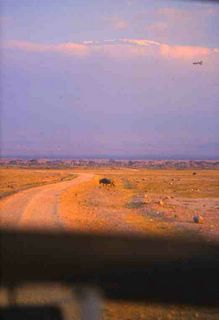
I don't know that I'd buy a plane ticket just yet, but I might go ahead and get some maps and guidebooks and start dreaming about a Kenyan safari to magnificent places like Masai Mara (photo) and Amboseli, true places of a lifetime.

www.LoriHein.com

February 27, 2008

Not quite hakuna matata


My film is off being developed. Thanks again to Dana for letting me post one of her photos.

There were a few things, some bigger and hairier than others, that weighed on my mind before and during our Uganda experience, things that could unravel and fall apart and cause us problems.

None of my worries involved gorillas. When I told people we'd be 15 feet from these wild creatures (we were actually as close as seven feet, but don't tell the Uganda Wildlife Authority), some folks marveled at that while others leapfrogged to images of us being mauled and eaten: "What if they attack?"

They've been so carefully and expertly habituated to human contact that I knew they wouldn't -- the only time a habituated mountain gorilla has charged a tourist was years ago when a professional photographer decided the "no flash" rule didn't apply to him and was put in his place by a silverback. He survived to tell the tale of his hubris and stupidity.

No, here's what I worried about, in ascending order of hairiness:

1. We'd miss flights and connections: With layovers of under three hours between the five flights we'd make on our roundtrip journey, any delay anywhere could be the domino that toppled the works. Snow at JFK would mean missing Amsterdam, which would mean waiting a day for the next flight to Nairobi, which would put us in Entebbe with just a day to spare before the gorilla trek, booked and permitted specifically for February 18 and an 11-hour cross-country drive from where we'd touch down.

As it happened, our outbound flights went off like clockwork. It was on the way home that our two and a half-hour Heathrow layover disintegrated because the fourth engine of the Boeing 777 we took out of Entebbe wouldn't fire, causing us to sit on the runway for an hour and a half. "This happens often in Entebbe," said the flight attendant. "The thin air at this altitude causes problems." My goodness! I thought. Entebbe's at about 4,000 feet! What happens to a 777 when it tries to take off from airports with real altitude?

We made our Heathrow flight to JFK as it was boarding and the gate closing, thanks to the Indian driver of an inter-terminal airport bus who spirited us from our arrival terminal to our departure building several miles away and dropped us at a back entrance with a completely queue-free security checkpoint. "Get in madam!" he'd said, pointing to the empty bus that he was supposed to fill with passengers bound for all of Heathrow's far-flung terminals. "You WILL make your flight! I will take you there directly!" And he did.

2. We'd get stuck in Kenya: The recent post-election violence in Kenya has caused travelers to cancel safaris, the Peace Corps to pull out, and the State Department to advise Americans living in rural parts of the country to make their way to Nairobi. I'd registered our trip with the State Department and had signed up for email alerts for Kenya, Uganda, Rwanda and Congo, and the day before we left I received a warning about the deteriorating situation in Kenya. "International flights are still operating normally," read the message, "but be advised that this could change at any time." I knew traveling overland through western Kenya to Uganda would be extremely dangerous -- travelers had been attacked and armed Kenyans had ripped up portions of the rail line between the two countries -- so I made mental plans, should our flight to Entebbe not take off, to hunker down for the duration inside Nairobi's Jomo Kenyatta airport. I packed emergency Power Bars.

Our KLM 747 from Amsterdam to Nairobi was nearly empty. Sadly, every passenger had his or her own row for the nine-hour flight. In a plane that should have been full of excited tourists anticipating life-changing game drives in Kenya's magnificent parks, there was a single group of four American safari-goers.

I asked the flight attendant if all the Nairobi-bound flights had been empty recently. "Yes," he said, "they have. And this is our biggest plane. I guess they're sending the biggest plane so they have room on the way back for people who want to evacuate."

3. We'd get sick: Yes, this rated higher on the hairiness scale than getting stuck in Kenya because it was more likely to happen and because sick people cannot track gorillas. Contracting human disease is the biggest threat to habituated mountain gorillas, and if you have the least cough, sniffle or touch of diarrhea, you forfeit your gorilla permit and must stay behind. If you're sick and fess up, the Uganda Wildlife Authority will refund your $500 permit fee. If you're sick, try to hide it, make your foolish way into the gorillas' forest and are found out for the selfish idiot you are, the Uganda Wildlife Authority will deal with you, without humor.

So, I put me and Dana on a prophylactic regimen -- highly effective, as it turned out -- of Pepto Bismol, zinc, echinecea, vitamin C, bottled water and hand sanitizer. Before our 30 hours of transit inside germ-coddling airplanes, we coated our nostrils with saline spray and toasted each other with glasses of Airborne dissolved in water. At any hint of immune system breakdown, we cracked open tubes of Zicam and swabbed our nasal passages. Obsessive? Maybe.

But we were healthy on gorilla day. The day after that, I got a cold.

4. We'd have a close encounter of the Congo kind: In 1999, fugitive Rwandan rebels living and hiding in eastern Congo near the Ugandan border stormed a tourist camp in Bwindi Impenetrable Forest, where we went tracking, killing eight tourists and several Ugandan guides. While there have been no attacks on human visitors to Bwindi since, and the Ugandan government maintains heightened security in the forest, and Rwanda is at peace, no one has a crystal ball that says such horror will never happen again.

The current and more likely threat is from Congolese rebels fighting against the government of the Democratic Republic of Congo, and these bad boys live in the Virungas, the series of lush, volcanic peaks shared by Rwanda, Congo and Uganda that are home to Earth's mountain gorilla population. In 2007, in four separate attacks, Congolese rebels murdered 10 of the planet's 700-odd wild mountain gorillas. Some were killed for bush meat, others to focus attention on the rebels' cause and unmet demands. The murders were carried out scant miles from Bwindi and the Ugandan border where we were trekking.

We set off on our trek from a ridgetop road that led into Congo, five miles away. As we hiked, I looked into Congo at nearby forested peaks knowing they harbored men with no respect for life.

I'd told Dana that "men with guns" would accompany us on our trek so she wouldn't freak when she saw them. There was a rifle-toting ranger leading our party, a second one bringing up the rear, and, I'd heard through the grapevine, others hidden in the forest along our route.

I'd told Dana the armed men were there to protect the gorillas, which is, of course, true. But I think, if confronted, they'd be swift to protect themselves and their human charges, as well. I was damn glad to have them along.

www.LoriHein.com

December 06, 2007

Bookstore souvenirs

I traveled to Cape Cod last night to see a dear friend and to sign books at a fundraiser for her daughter's school. The event was in Falmouth, one of my favorite Cape Cod towns, and was hosted by Inkwell Bookstore, a beautiful shop on Falmouth's Main Street. If your travels take you to the Cape, pop in and browse and say hello to owners Kathleen and Michelle.

Books make wonderful travel souvenirs. Forays into stacks and along shelves of booksellers around the world have netted me a collection of interesting and quirky titles. Among them:

From Jamaica: Mi Granny Seh Fi Tell Yu Seh: The A to Z of Jamaicanisms, with advice on topics like Grief, Family, Confidence, Patience and Aspiration. From the chapter on Opportunity: "Hog wash enna de fus wata 'im ketch." Translation: "A hog washes in the first water he sees/Take advantage of the first opportunity."

Also from Jamaica: A Code of Conduct For Police-Citizen Relations. The "Attitudes of Approach" section offers this advice for citizens approached by the police: "RUNNING AWAY: Whether you have committed an offence or not, irrespective of how frightened you may feel, DO NOT RUN AWAY! TO DO SO MAY MAKE YOU APPEAR GUILTY."

From China: A dutifully well-thumbed, pocket-sized copy of The Quotations of Mao Zedong, known in the West as the Little Red Book. I can't read the copyright date because it's in Chinese, but it's clearly Cultural Revolution-era, when carrying the book and studying it daily were compulsory. I bought it from a sidewalk bookseller and paid him his two dollar asking price without haggling. Pleased with the ease and profit of the transaction, he threw in a free antique porcelain teacup.

From a Bergen, Norway souvenir shop (photo) that stocked trolls and kiddy lit: colorful chapter books with blond, rosy-cheeked tots on their covers and Il-Vjaggi Ta' Gulliver. Gulliver's name's the same, but, being plurals, Lilliputians become Lilliputjani in Norwegian.

From an antique and used book shop in Eton, England, home of 15th century Eton College and a short footbridge walk over the Thames from Windsor Castle: How to Lay a Nest Egg: Financial Facts of Life for the Average Girl, copyright 1950. It begins: "Ladies, this book is about You. Some girls (that includes the author's wife) have long wished they could lay eggs instead of having children the cumbersome human way... But laying a nest egg is something else again; something quite within your power -- yours alone, no daddy required, not even a sugar daddy."

From Kenya: Wisdom of Maasai. The introduction tells us "these proverbs reveal the knowledge inherited by the speakers of Maa. It is good that the children read this wisdom so that they do not forget completely. Proverbs are an integral part of the Maasai language. A Maasai hardly speaks ten sentences without using at least one proverb." A sample from the "Conduct" chapter: "Menyanyuk enchikati enkutuk o eno siadi/ The odour from the mouth (words) is stronger than the odour from the arms."

In Perros-Guirec in Brittany, a region in northwest France that sits on the sea and has deep Celtic roots, I picked up a little green book of Breton proverbs, Krennlavariou Brezhonek. The book delivers its gems in Breton, French and English:

"A bep liv marc'h mat, A bep bro tud vat/ De toute couleur bon cheval, de tout pays gens de valeur."

Translation: "Good horses come in all colours, good people come from all countries."

July 05, 2006

Wildebeest migration: A view to a kill


The wildebeest are on the move.

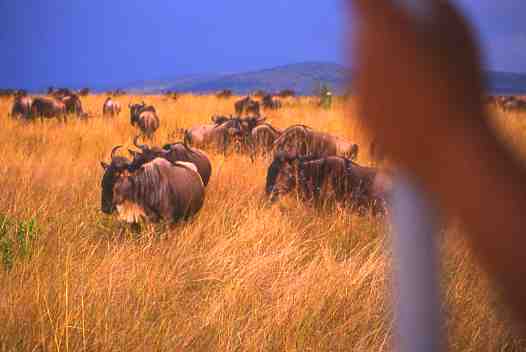
Each spring, tens of thousands of wildebeest move north from Tanzania's Serengeti plain and head for the sweet, plentiful grass of the Masai Mara in Kenya. The endearingly ugly, bearded gnu will graze in the Mara until November, then return south to the Serengeti.

In July, the Mara is a sea of wildebeest. The Jeeps and Rovers and kombi vans that take camera-toting tourists out on dawn and evening game drives phase the gnu not at all. They chomp and stare and nuzzle and sashay while tourist vehicles ply thin dirt tracks that cut right through herds that can number in the hundreds. The annual migration is a visual feast for tourists. And a literal feast for lions.

During the blazing midday hours, lions sleep in the grass behind rocks and boulders and in the shade of the wispy acacia trees that dot the savannah. Tourists sleep, read, swim or gather at the bar at their fenced camps and lodges, passing the hot hours until the evening game drive. While lions and tourists rest, wildebeest graze unmolested.

About 4 p.m., safari vehicles roll out of the gates and bump across rutted tracks in search of game. Lions stir. Wildebeest become wary.

Near the end of our second evening drive on the Mara, our Star Travel and Tours guide, Herbert, a master at finding wildlife and delivering us into scenes of such utter animal majesty that we often could not speak, motioned for us to be still and, about 10 yards from a collection of tall gray stones half-hidden by thick shafts of golden grass, cut the engine of our white pop-top van and pointed toward the rocks, on our left. A herd of some 50 wildebeest, many babies, stood stock still on our right. The distance between rocks and gnu was less than a hundred feet. We’d been with Herbert for a few days and knew we were going to see something special.

It was 6:15. Our lodge imposed a 6:30 p.m. deadline on vehicle drivers. All vehicles carrying tourists were to be inside the lodge gates by 6:30. Searches would be mounted for any vans not accounted for by that deadline, and the drivers would be reprimanded (unless they’d been eaten). Herbert had a habit of cutting things close, but every risk he took was, we’d learned, wisely calculated, and we trusted him.

The wildebeest stared and seemed unsettled. Mothers stood near their young. Some in the herd had begun galloping lightly on the spindly legs that didn’t seem to match their meaty bodies. They bounced and bounded, then reversed direction in quick, snapping turns. Then they’d stop and stare, beards brushing the tops of the tallest grass.

The grass near the rocks began to move, and, with Herbert’s finger to guide us, we made out a pride of seven lions silently slinking closer to the road we sat on – and to the wildebeest, who were clearly on guard. The lions’ stealth was at once frightening and awesome. They moved as a strategically trained unit under the direction of a young, maneless simba. He moved his pride of mature females and fit cubs through the grass, inch by inch.

6:20, 6:25. The lodge gates, miles away, were about to close, and the rest of the tourists were already tossing back Tuskers at the lodge bar. We had to go. The lion pack was at the road, a few feet from our van. Herbert started the key in the ignition, and we looked at the wildebeest, wondering which of them would go down tonight.

At 6:30 the next morning, we met Herbert and left for a dawn game drive. Spellbinding is too weak a word to describe the early morning Mara.

While the evening drive shows you the hunt – meat-eaters planning canny, quiet takedowns of plant-eaters – the dawn drive shows you the hunters’ handiwork and the manic collection of carrion eaters who feast on remains the hunters couldn’t finish. Evening is for predators, dawn for scavengers.

Two lionesses and three cubs, bellies bulging with wildebeest, crossed the road in front of our van, languidly making their way back to their resting place on a low, rocky hillock. They’d sleep until evening.

Herbert parked the van, and we watched four wild-eyed hyenas, snouts flaring, dash through the brush to rip chunks of flesh or a spindly leg from a nearly-stripped wildebeest. They tore their prizes off quickly, and emitted sick-sounding yelps as they slunk off to chew before darting back to the kill. The hyenas were covered in blood. Hyenas do kill, in packs. But wildebeest season affords them the lazy option of letting lions do the work. Lions take the lions’ share, but then the hyenas eat leftovers for free. Hyenas may be ugly, but they're not stupid. Why break a sweat if you don’t have to?

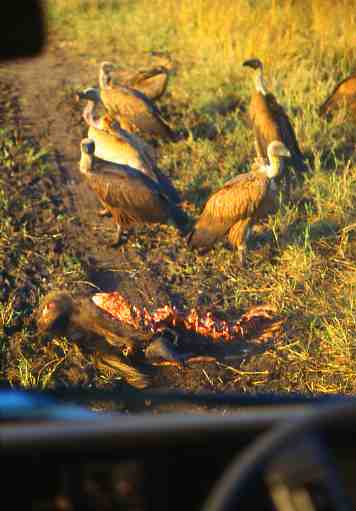
Jackals nipped at the wildebeest flesh, and whenever one scored a piece, one or more hyena would reign terror on the jackal, chasing him through the savannah until he dropped the meat. Between hyena raids, swarming vultures picnicked on the gnu’s head and neck. Lustily. They approached the remains with ugly, hopping gaits and spread their wings as if to keep outsiders from their meal. They made a smacking, sucking noise as they descended upon the bloody, bodyless head.

When the wildebeest had been stripped, save for the hair on his face and forehead, the hyenas gathered for dessert. We watched as they raised ribs and femurs to their loud lips and listened to the sound of teeth crunching bone.

I looked up from the scene and watched a hot air balloon, brilliant stripes against the purplish-blue rising of the sun, ferry well-heeled tourists, at $350 a head, high over the Mara on a dawn champagne flight.

I pitied them for what they were missing.


www.LoriHein.com


May 04, 2006

Tim Leffel's new Perceptive Travel magazine: To Nairobi and beyond...


Tim Leffel, author of The World's Cheapest Destinations, recently launched a great new online magazine, Perceptive Travel, and the third issue is out.

Perceptive Travel delivers quality storytelling by some of the best travel writers around. The magazine's first two issues featured stories by people like Rolf Potts, Jeff Greenwald and David Farley. Sign up for the Perceptive Travel Newsletter to receive an e-mail alert each time a new issue is released.

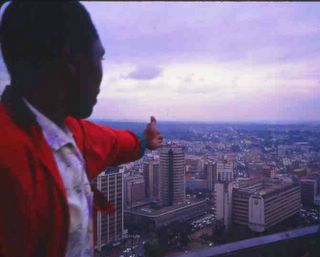
In the new May/June edition, I take you to the top of a Nairobi skyscraper, where Daniel, the building's janitor, gives me a 360-degree tour of his city and shares its problems and its possibilities. Click here to read Nairobi by Degrees. Enjoy the journey.

www.LoriHein.com

January 18, 2006

Elephants assume the throne

I cut a photo from a recent issue of This Week magazine and hung it on my refrigerator. It’s a picture of a great, gray Asian elephant sitting on a massive concrete toilet, and it bears the caption, “Don’t forget to flush.”

The accompanying story shares the news that “weary trainers”
at a Thai animal preserve have taught seven pachyderms to poop in a giant potty. Whenever bits of their hundred pounds each of daily food start knocking, the elephants plop their rears on the throne, do their business, then use their trunks to pull a cord that flushes what is likely the world’s largest loo.

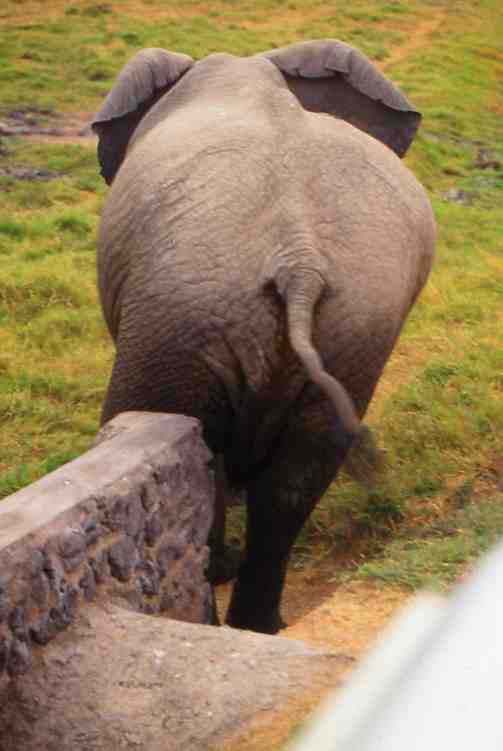
I’ve seen an elephant sit, and it’s a rare thing to behold, especially from behind. (Sorry. It's hard to resist wordplay when it stares you full in the face.)

I could have, should have, popped off a better shot (photo above) of this African elephant’s rump, but I was momentarily pollaxed by what I was looking at and missed capturing the exact moment when the geometry of his big booty was perfectly square with the stone culvert he was scratching himself on.

We were in Amboseli, on the last of our Kenya game drives, and Herbert, the Star Tours driver who’d shared his land with us over the course of a sublime week, was determined to find final, marvelous things for us to see before we said goodbye. He delivered.

The clouds parted, revealing Kilimanjaro and her vanishing snows. We’d already seen, thanks to Herbert’s knowledge and skill, all of the Big Five, including the elusive leopard, but on this last day, we found our first hippo and studied his bulbous face through Herbert’s binoculars. We watched a herd of giraffe, legs splayed, as they sucked salt from a powdery white lick that ran next to a sparse stand of acacia trees. A lioness, on her back with legs up and white belly exposed to the sky, played with her three babies.

All this was enough, but then came the young sitting bull. He sashayed toward us, gave us an elephant-may-care look, turned, sat down on the concrete, and, with great effort and purpose, scratched away that African day’s bugs, dust and other indignities.

Then, business done, he got up and walked away.

LoriHein.com


November 22, 2005

Masai at dinner


I’m cooking for 10 this Thanksgiving, and I’ve just set the table. There’s a little piece of Kenya there in the dining room. The yellow, green and black dinner plates sit atop a large rectangle of red plaid Masai material I use as a tablecloth.

Masai men wear the cloth tied over one shoulder and passed under the opposite armpit. The garment, often red to signify power, stops just short of the knees. The first time I spread the vivid cloth over our table I wondered what the Masai would think of my decorating an American mealtime with an article of their clothing. But they sell the cloth at souvenir stands, knowing, I’m sure, that tourists don’t buy it to wear to work. They must wonder what we do with it. I like to think my use would please them, that they’d like being a colorful, vibrant addition to our dinnertime gatherings.

I bought the cloth for a few dollars at a stall (above) atop the escarpment of the eastern wall of the Rift Valley, the mammoth geologic fault that runs from Syria to Mozambique. Although the day was foggy, the spectacular vista yielded magical views of Mt. Longonot and of the savannah and Masai lands spread across the valley floor. The vendors at the Rift Valley Lookout held out jewelry and wood carvings, beadwork and soapstone, but I headed straight for the tablecloths.

The stall owner asked what country we were from. “America,” he nodded, with a one-upsmanship smile. “Kenyans are famous in your country. As runners.” I laughed and told him we were from Boston and that we’d watched plenty of Kenyans burn up the pavement and earn the laurel wreath in the Boston Marathon. “Yes, we always beat you,” he grinned. I asked if he was a runner. He wasn’t, but he did count some of the distance greats as friends. “They train there, in Eldoret,” he said, and pointed toward the high altitude running mecca away in the distance.

Tablecloth bought, we continued down the Rift Valley escarpment road, built during World War II by British East Africa’s Italian prisoners of war. We passed a small chapel the Italian soldiers built so they could worship during lulls in construction. A group of baboons sat on the road edge across from the chapel. They chattered and ate and picked bugs from each other’s coats.

Between sips of wine, forkfuls of turkey and snatches of Thanksgiving conversation, I will look at my tablecloth and remember Africa.

LoriHein.com


October 17, 2005

Nairobi by degrees


The security guard and the official building information officer both quizzed and vetted me before handing me to Daniel, a janitor at one of Nairobi’s skyscrapers. I’d asked permission to ride the elevator to the roof for a panoramic view of the city. We agreed on a price, “to be paid later,” and Daniel was tapped to be my guide.

Daniel stashed his broom in a corner under a stairwell and smoothed his bright red cleaner’s smock, torn under both armpits. He led me to the elevator, crowded with workers making their way to the offices and cubicles nested inside the tall building. Daniel gently pushed them aside to make room for me.

We rode to the last stop where the elevator door opened to reveal a ticket booth of sorts. I handed 50 shillings to two giggling Muslim girls in gray headscarves half-hidden behind the opaque Plexiglas of the makeshift kiosk. In unison, they nodded an OK to Daniel. He grinned, said, “This way, please,” and bolted up a concrete staircase to the rooftop helipad, round and high and open to the blue-purple African sky.

Daniel became a bird, his cotton smock feathers and his arms wings as he moved around and across the helipad, mouth laughing, eyes dancing, soul savoring this release from pushing his broom. He jumped from one thick neon-yellow landing sight line to the next, arms outstretched, whirling like a top, canvassing the 360 degrees of Nairobi splendor and squalor laid out below and beyond.

When he came to rest, his arm pointed like the arrow on a board game’s spinner toward Mount Kenya in the northeast. Serendipity or stagecraft? He began my 360-degree tour with this jagged exclamation mark – wild, raw, powerful, like Africa itself. “On a clear day, one can see both Mount Kenya and Mount Kilimanjaro from this point,” said Daniel as he tilted his head to the right to find Kili’s snow-capped top.

Over the next hour, one of wonder for me and freedom for him, Daniel moved me counterclockwise around the roof, degree by degree. Each new eyeful triggered talk and tales. The more he could say about the beauty and baseness, majesty and mud, coffee and corruption, the longer he could leave his broom under the stairwell.

Daniel, once a teacher, reveled in the immense embrace of his land. Sharing it gave him great pleasure. He spoke of its problems and possibilities with equal passion.

From the terra cotta roofs of City Hall and the precise walls of the Anglican cathedral, we looked northwest toward the rich, purple Ngong Hills. Daniel talked of the vast tea and coffee plantations there, flanked by wealthy white suburbs. We took in the expanse of Nairobi National Park, whose location hard by the sprawling airport and industrial sector belies its role as a key migratory corridor for big game.

Directly below us a mass of people made its way from Uhuru Park to the office of Kenya’s president and, with a booming collective voice, they asked for an end to the corruption and violence that plague the city and country. Tourists in bathing suits stood at the railing of a luxury hotel’s rooftop pool and watched the scene.

I looked down on the place where the American embassy had once stood. A park now marks the site of al Qaeda’s depraved handiwork. Daniel remembered the day of the terrorist bombing with horror. He sighed deeply and spoke of the “hundreds of Kenyans who will not be there again.” Thousands injured, some left deaf or blind. A passing bus lifted 10 feet in the air, killing all on board. “A noise I never want to hear again,” whispered Daniel, as echoes of the blast seemed to roll through his bones.

Before we came full circle and again faced Mount Kenya, Daniel’s arm swept over the teeming slums of east Nairobi. Land dominion in the north, west and south is held by wealth, wildlife or commerce, so Nairobi’s poor spread eastward. Daniel guided my eyes to the city’s cruelest slum.

“That is where I live,” he said. “With my two young daughters.” He talked about the realities of slum life. His neighborhood has no running water. His daughters are in school, and Daniel struggles to keep them there, learning. Some of his 200 shilling per month salary goes to corrupt teachers and school officials for fake fees and books that never appear. If Daniel doesn’t pay this “money for nothing,” his daughters pay consequences meted out by people a link above him in the food chain. People with just enough power to make a poor family’s difficult life harder.

Clouds began to hug Mount Kenya. Daniel made a last spin around the helipad, his red smock flapping. He tilted his beautiful face upward and smiled at whatever god had granted him this hour’s relief from mop and bucket. I handed him a tip, a janitor's monthly salary, money likely to become money for nothing, and we rode the elevator down to the building lobby.

After a few minutes, I left the building and walked across the plaza, heavy with sober law courts and massive statue of a robed Jomo Kenyatta. I looked back toward the tower. There was Daniel, outside in the sun, smiling softly, sweeping the cobblestones.

www.LoriHein.com


June 02, 2005

The Masai Mara: Twenty-three elephants


On safari in Kenya, our wake-up calls came at 5:45 a.m., and we’d meet Herbert, our driver, at 6:20 for dawn game drives.

On sunset game drives, we witnessed the hunt, lions and other predators crouched in tall savannah grass, craftily creeping toward grazing wildebeest.

On dawn drives, we saw the scavengers, beasts that ate the remains of kills brought down the night before by the carnivores at the top of the food chain. Hyenas and vultures ripping and pecking at the barely identifiable remaining skin and flesh of zebras and gazelles, animals, which, the previous evening, had graced the Mara with their elegant, supple beauty.

Outside of this circle of life and death lumbered the elephants, too big to harass, too tough to be tasty. These herbivores wandered the Mara and places like it in a sort of elephant-only cloud, keeping to themselves and generally being left alone, save for the white bug-picking birds that rode their backs. Like most host-parasite relationships, this one works. Elephants stay insect-free and birds enjoy a moveable feast.

One morning, Herbert steered us into the Ultimate Elephant Experience. We’d sat with other vans, called kombis in safari-world vernacular, and watched a herd of elephants cross the savannah and head down a grassy knoll toward a rare cluster of trees that ran a half-mile or so. As the elephants bounded down the knoll, the other drivers left, confident they’d given their clients enough elephant time for this drive. I’ve no doubt the travelers were satisfied with their morning outing.

But Herbert was a zebra of a different stripe. A man who eschewed mediocrity and settling. An impassioned professional and gentleman whose mission was to reveal his beloved land’s every secret and nuance – or as much as he could reveal during the week we spent with him.

As the other vans turned right to head back to the various camps where their clients were staying, Herbert kicked our pop-top into gear and sped toward the clump of trees the elephants had headed for. I looked at Mike and the kids. Hang on, guys. We hired the right driver.

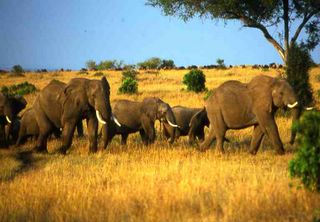
Herbert knew exactly where the elephants would emerge from the trees, and there we sat. He turned off the ignition, and we waited. My mind blew as, one by one, the elephants we’d seen from a distance walked from the trees not twenty feet from our van’s front grille. We were alone with a sublime parade of land leviathans, and none of us will forget the experience.

Out of the woods came a great bull elephant. Then mothers with babies trailing behind. A big-tusked bull led two babies out of the trees. I asked Herbert the calves’ ages. “About six months and one and a half years,” he said, drinking in this spectacle as deeply as we were.

We watched as, almost within touching distance, twenty-three elephants emerged from the woods and passed before us. I shot a roll of 36 slides in about four minutes. This rumbling, moving herd of pachyderms was one of the most stunning visions I’ve ever seen.

The lead bull led his clan of twenty-three to a water hole hidden in the bushes beyond the small dirt track our van sat on. We watched in awe as the elephants, young and old, small and gargantuan, bent their heads to dip water into their mouths, then moved their trunks into their mouths to drink the water down. We watched them inhale mouthfuls of tree branches and then tuck some extra under their leathery brown chins for future use.

Beyond, behind and aside us, the savannah baked in the African sun, wildebeest grazed in peace until the lion hour, and acacia trees spread and drooped like giant, life-giving umbrellas.

www.LoriHein.com


May 01, 2005

Kilimanjaro takes off his poncho


In March, Reuters distributed an article about a London meeting of the world’s biggest polluters. Ministers and leaders gathered to discuss the imperative to reduce carbon emissions. (The US was represented, but, as far as this American can tell, emerged thinking Kyoto Agreement means little more than acting civil while in a lovely Japanese city north of Osaka.)

To spur the ministers to outrage and action, photos were shown of a bald Mt. Kilimanjaro, evident victim of global warming. Kili, 19,340 feet at the tip of Kibo, the tallest of its three summits, sits in Tanzania near the Kenyan border. The highest peak in Africa and one of the world’s highest freestanding mountains, Kili has, for ages, been a symbol of wonder, elusiveness, striving and a source of inspiration and strength. I wrote a story about Tim Saunders, a Massachusetts man who climbed Kili in 2003. “If God lived on earth,” Saunders told me, “I imagine this is what His place would look like.”

His place looks different now. The snows of Kilimanjaro – Kilima Njaro or “shining mountain” in Swahili – are almost gone. The photo above, taken a few years ago, is the best I could get from Kili. Covered in clouds during most of our visit to Kenya’s Amboseli National Park, the legendary snowcap seemed small and vulnerable whenever it showed itself.

When I read the Reuters article and considered the now nearly snowless Kilimanjaro, my mind flashed back to a van ride across the Bolivian Altiplano.

Adam and I were on our way to Lake Titicaca with Mario, a wizened old driver able to see through roiling clouds of Altiplano dust, and our guide, Federico, a young doctor who had just finished his internship and was trying to qualify for a residency program in Germany. He moonlighted with La Paz’ Crillon Tours to earn extra money for that hoped-for air ticket to Frankfurt.

For two hours, we drove up close and parallel to the Cordillera Real, a string of Andes that blew my mind. From Illimani that looms over La Paz to Illampu near Lake Titicaca, the ride was a nonstop visual feast of some of the world’s grandest peaks.

One looked barren. Chacaltaya was mostly stark brown in comparison to its brilliant, snow-draped neighbors. There might have been more snow on the side I couldn’t see, but Chacaltaya, site of the world’s highest developed ski area, looked rough and rocky. When I suggested to Federico that perhaps the mountain was mad at people for skiing on him, Federico looked at me as if I’d opened a door he never expected me to be able to unlock.

“Every mountain is an abuelo – a grandfather – and a great spirit,” he said softly. “When a mountain loses its snow, it is cause for much concern. We say that the grandfather is taking off his poncho.” When an abuelo takes off his poncho, Bolivians believe the grandfather is preparing to act in some way that will affect the lives of those who live near the mountain. Federico said Chacaltaya had been slowly taking off his poncho for five years.

Kilimanjaro is taking off his poncho. Is he telling us he’s angry at how we treat our world? Kili and Chacaltaya stand on different continents an ocean apart, but the indigenous people who live under both recognize them as elders to be honored, earthforms with spirits. Perhaps the two grandfathers talk to one another, wondering whether mankind will heed the message sent each time another abuelo begins to take off his poncho.

Join me during May at BoomerWomenSpeak.com's Featured Author forum.


February 08, 2005

Overnight trains


We've made summer travel plans. Mike and Adam will travel two hours north to our New Hampshire cottage and spend a week painting it. We’ve owned the place for 20 years, and this will be the first fresh coat it’s received from us. In New Hampshire, paint jobs, like people, are hardy and weather-resistant.

Dana and I are going to Russia. We’ll spend a few days each in Moscow and St. Petersburg. I can’t wait to see St. Basil’s wild-tiled domes and Peter the Great’s sherbet-colored palaces lining the Neva River, but what I’m really psyched about is the overnight train between Moscow and St. Petersburg.

When I was a student vagabonding around Europe, rail was my mode of transport, and overnight trains saved the cost of a hotel room. (That’s Backpacking, Lesson 1. If you’re female, you learn Lesson 2, How to Keep Safe, on the fly. Trust your instincts, ladies, and when intuition speaks, listen without question. If you feel the need to hit someone over the head with your pack, excuse yourself from the compartment, and sit on the floor near the well-trafficked and brightly lit bathroom, do so without hesitation or apology.)

Despite an occasional misadventure, I grew to love the trains. When we went to Kenya as a family not long ago, I booked us on the overnight train from Nairobi to Mombasa on the Indian Ocean. We didn’t sleep much, but we savored the experience.

Our cab driver, Emmanuel, deposited us at the Nairobi Railway Station. We bid him kwaheri, good-bye in Swahili, and went to the station’s central platform, where “LORI HEIN PARTY” was listed, with coach and compartment assignment, on the “Berthing Allotments” section of the station’s notice board. A railway worker in a white coat gave us four meal tickets for the train’s 7:15 p.m. seating.

We boarded, found our four-berth second-class compartment, and made ourselves at home. Dana read animal books and Archie and Jughead comics, Adam fired up the Gameboy, and Mike pulled out a copy of The Economist someone had left behind in the station waiting room. Luke, our “caretaker,” popped by to say he’d make up our bedding while we were at dinner. (When we returned he gave us a security drill, and his most urgent tip was to keep our windows closed at station stops to thwart thieves who’d try to reach into the compartment and grab things.)

A pair of stewards walked through our compartment banging a dinner gong, and we proceeded to the restaurant car. Dinner was orchestrated like a rolling ballet, white-coated waiters serving drinks, soup, bread, and rice and curry in an efficiently choreographed performance that gave you just enough time to eat, and them just enough time to clear, before the next seating. Dana, in the photo above, was dubious about the curry – she saw chicken in it. Not much of a flesh-eater, this girl has clothing that reads, “Spare an animal. Eat a vegetable.”

As we rolled toward Mombasa on this railway that Queen Victoria ordered built in 1898 to best the Germans in the European chess game of dominion in East Africa – Victoria and Kaiser Wilhelm lived to outdo one another – I stayed glued to the window, recording every nighttime scene and nuance in my journal. Over a dozen stops. Emali, Kiboko. Makindu with its beverage stall lit up bright in the black night and music playing. Darjani, where a full African moon lit the landscape and a lone, powerful southern hemisphere star commanded the heavens. At each stop, I heard nighttime voices and the sound of leather sandals padding the platform outside our window, hurrying to get on the train before it slithered southeast to the coast. Mtito Andrei, where big rigs traveling the dangerously narrow and monotonous Nairobi-Mombasa highway were parked, waiting for daylight. The road parallels the tracks, and I’d experience occasional middle-of-the-night terror when an 18-wheeler barreled next to our train, engine and headlights blazing.

I remember Voi at 5 a.m. A road and railway commerce hub that sits between Tsavo National Park’s east and west sections, the outpost was humming with trucks and trains, all moving, transporting goods from one piece of East Africa to another. Before we reached Voi, I’d looked out onto Tsavo – the Nairobi-Mombasa train rolls right through it. Twenty-eight indentured Indian slaves, part of the contingent “recruited” to build the railway from Mombasa to present-day Uganda’s Lake Victoria, were eaten by lions in the landscape I looked upon. Two man-eaters plagued Colonel John Henry Patterson’s railway-building camp, carrying workers away in the middle of the night, feasting on them, leaving only limbs and bones behind. Patterson himself eventually shot and killed the two lions, and his 1907 classic, “The Man-Eaters of Tsavo,” recounts the whole bloody ordeal.

I’m excited about my next train ride. Overnight from Moscow to St. Petersburg. Will I sleep? Or, as it was in Africa, will so many fascinating vignettes pass outside the window that sleep is rendered impossible...


Ribbons of Highway proceeds continue to go to tsunami relief. The headlines have faded, but the need hasn’t. Details here.


December 03, 2004

Visit to a Masai manyatta


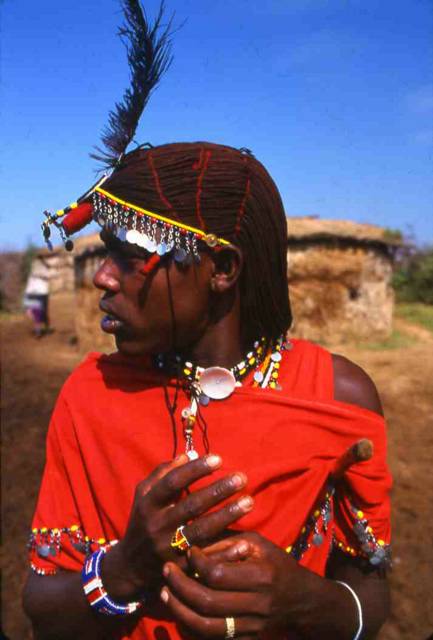
"Make as many pictures as you can," said Dixon, turning his head to let me photograph the long braids dyed with red clay that signified his status as part of the Masai (Maasai) morani, or warrior, class. Dixon's 70-member clan earned revenue from tourists visiting their manyatta. The trade was lucrative, and the clan had been living in this location within Kenya's Masai Mara National Reserve for three years. They were still pastoralists, their lives centered around raising cattle, but tourist dollars had enticed them into putting down roots and eschewing their traditional nomadic way of life.

Dixon, son of the clan chief, was our host and guide. While he spoke Maa to his clansmen, he talked with us in eloquent, flawless English, perfected during the 11 years he'd spent at a Narok boarding school.

He pointed to the sturdy, dung-walled huts arrayed throughout the manyatta. "Each house is the house of a wife," he said, "and each wife must build her own house."
Masai men may have more than one wife and, explained Dixon, they "spend one or maybe two nights within a wife's house and then move on to the house of another wife." Dixon would soon take his first wife, chosen by his father. Dixon would meet her for the first time on the day of their marriage. She was from a different clan and would move to Dixon's manyatta and build herself a dung house. Masai women also maintain their houses and, each morning, they collect cow dung and slap a reinforcing coat onto roofs and walls.

We entered Dixon's mother's house, pitch dark and smelling of animals, dirt, burnt firewood and kerosene. The single kerosene flame that flickered in a corner was useless against the hut's dark closeness, so Dixon opened a tiny vent in the dung wall to allow in enough light to see. We sat on his mother's cowhide-covered bed, a raised mud platform built several feet from the cooking fire. "This is our simple kitchen," said Dixon, as he ran his fingers over and explained all of its contents -- a gourd water calabash, a pot, an iron grate to hold the pot over the fire, and a few sticks of firewood. The Masai diet is exclusively the blood, milk and meat from livestock, "except," explained Dixon, "in times of drought, when the government provides cereals, grains and vegetables."

We heard rustling from a dark recess on the other side of the hut and peered through the blackness to see a pile of children resting in a sleeping nook. The Masai's sleeping arrangements intrigued me, as they involve much moving and arranging of people and animals. When night falls, the cattle come inside the manyatta, the stick fence that surrounds the community affording protection from the Mara's hungry nighttime predators. Lambs and calves sleep inside the huts, in rooms built just for them. Masai men choose their wife du jour (or nuit) and go to her hut. When a man selects a wife and household with children, any boys over the age of 10 must leave the house and sleep in another hut -- one without a visiting husband in it.


So much pre-bedtime shuffling. I'm tired just thinking about it.

LoriHein.com

Where shall we go next?