Showing posts with label Tibet. Show all posts

February 18, 2011

Machu Picchu: Just a pile of rocks

Dana's heading to Peru and Bolivia this summer for a semester of intensive Spanish language study. She and the other students from her college will live with Peruvian families in Lima and Cusco. The kids will spend four hours a day in class, but there will also be plenty of sightseeing. Machu Picchu, is, of course, on the list.

Most travelers set out for Machu Picchu from Cusco, a chocolate-brown city where Spanish colonial architecture sits atop ancient walls built by the Inca. Cusco is in the foothills of the Andes at about 11,000 feet, an altitude that creates oxygen deprivation problems for visitors who don't or can't take enough time to safely and gradually acclimate. I trust that the folks running Dana's university program will ensure that the students go slowly their first few days in Cusco and that their day trip to Machu Picchu is scheduled for the back rather than the front end of their Cusco stay.

Otherwise, somebody's bound to miss Machu Picchu. Somebody will be decked by altitude sickness, or soroche, and the excrutiatingly painful headache that is arguably its least pleasant and most frightening symptom. I've experienced brain-beating soroche in both Cusco and Lhasa, Tibet and a milder version in Quito, Ecuador. When your head feels like a crazed, invisible hand is attacking it with a hacksaw, sightseeing, even to one of the world's major wonders, is out of the question.

Mike and I went to Peru on a package tour that spent three days in Cusco. Luckily for me, the Machu Picchu excursion fell on the third day, by which time my soroche had passed. Each successive Cusco day brought a visit to increasingly spectacular Inca ruins. My Day One misery kept me in bed at the Holiday Inn while my tripmates visited Ollantaytambo, which I will always regret having missed, but by Day Two I felt human enough to join the tour of spectacular Sacsayhuaman, spread across a hillside overlooking the city. By Machu Picchu day, my head didn't hurt one bit -- although my stomach was nauseated and roiling from the juice of all the coca leaves I'd chewed to help dull my headache. Mike had bought me a giant plastic bag of coca leaves from a sidewalk vendor. Both natives and tourists chew the stuff all day.
One member of our tour group -- I think his name was Ed, so I'll call him Ed -- wasn't as lucky as me. Ed's soroche seized him on arrival in Cusco and didn't let go until the morning of our departure on Day Four. Ed missed Ollantaytambo, Sacsayhuaman, the rich sights of Cusco itself. And Ed missed Machu Picchu.

Early in the morning on Machu Picchu day, the day that was everyone's raison d'etre for traveling to Peru in the first place, we unafflicted tourists gathered in the Holiday Inn lobby bubbling with anticipation and excitement. The tour leader did a head count: one shy. Sadly, Ed was evidently still abed.

Then he appeared. Ed hobbled down the stairs, entered the lobby, sat in a straight-backed wooden chair, leaned his head against the wall, and began to cry. Some of us cried, too. Then we left without him.

Machu Picchu was spectacular beyond description. To see it, stand in it, revel in the knife-like, velvet-green peaks that surround it is a powerful, enduring experience.
But the glory of the experience was tempered by the knowledge that Ed, who, like us, had traveled a quarter of the globe expressly to stand in this remarkable place, wasn't there.

When we got back to the Holiday Inn, Ed was in the lobby, in the straight-backed chair, and his sad, expectant face knocked any residual joy out of us. An unspoken pact united everyone in the group. When Ed asked, "How was it?" we made our faces long and mumbled, "It was OK" and quickly dispersed to our respective rooms.

We didn't speak of Machu Picchu for the remainder of the trip.

www.LoriHein.com


August 15, 2010

Our Lady of the Landslide


When we arrived at the airport gate to meet our fellow travelers for our tour to Tibet, my husband Mike and I rested our eyes on the only group there, an animated knot of senior citizens. We, then in our 20s, exchanged eyebrow raises. Our journey would include a 700-mile overland drive from Lhasa, Tibet to Kathmandu, Nepal across some of the planet’s harshest high-altitude real estate, landscape so challenging that the tour brochures contained warnings to consult your physician before booking. We trusted that everyone had.

We bonded for a few days in Hong Kong before heading to the roof of the world. Except for us and 30-year-old sheep farmers John and Wimpy, our cohorts were septa- and octogenarians. We connected with raven-haired Lois, who wore dresses, hose and heels nearly every day, even in the Himalayas; Morris and Christine, sweet South Dakotans; elf-like Clarence from Calais, Maine, who wore a peaceful smile but rarely spoke; and Bob, who brought yellow balloons that he blew up whenever kids were around. We were 32 in all, well-traveled and open to adventure.

Our first Tibet days brought magic: the hilltop Potala, once the palace of Dalai Lamas; temples lit with yak butter lamps and filled with chanting monks and earnest pilgrims; prayer wheels turning and prayer bells tinkling; yak skin boats and fields of golden mustard; aquamarine lakes and Earth’s mightiest mountains.

But as we moved farther from Lhasa and up onto the otherworldly central plateau, where nomads roamed, settlements sat a day apart and roads ran at 15,000 feet, things changed.

None of us had expected creature comforts. We were prepared for the dust, wind, rough roads, washouts, intense sun and altitude sickness that are the minimum price of admission for visitors to this astounding land. But we were unprepared for other costs that accrued as Lhasa began to feel like a distant memory, Kathmandu like a far-off dream. We had a tough in-between.

Food and water went first. When we passed through towns we’d stop at local restaurants and eat sausage, barley dumplings and acrid yak butter tea. Otherwise, we ate from the back of our microbuses, which had purportedly been packed with enough staples to last until Nepal. We enjoyed the spartan picnics until the day we realized that rationing had begun. The guides no longer opened the tailgate and let us take what we wanted. Instead, they’d place broken bread and a few cans of Spam, stewed tomatoes and mandarin oranges in a box, lay it on the ground, and invite us to divvy up the contents. The canned tomatoes and oranges were prized because they contained juice. Our water was almost gone, and for days we’d been traveling across Tibet not only hungry, but dehydrated. And, if you were Morris and Christine, who’d quietly mentioned they were diabetic, scared as well.

Leadership went next. We had two guides: the tour company’s American guide, whom I’ll call Bert, and Lu, the Beijing-based guide assigned by the Chinese government, which rules Tibet. Each wanted to be top dog. Instead of cooperating, they stopped communicating. We would pay dearly for that.

We’d been told before leaving home that a landslide had rendered impassable a stretch of road just beyond the Tibet-Nepal border crossing. Helicopters, we were told, would meet us and airlift us over the slide.

We arrived in the Tibetan border town that sits on a mountainside above the bridge linking Tibet and Nepal. Everyone hikes down, as there’s no road. We settled into a hotel at the lip of the border trail and slept.

In the morning we joined a parade of border-crossers. Queued up to exit China were traders with boxes strapped to their backs; laborers; local families; chiseled French couples in technical fabrics; sturdy Germans with walking sticks; backpacking Americans; a young solo woman with a beaming face and hair tucked under a white bandana; us, and the porters Bert had hired to carry Lois, Clarence and our baggage. Clarence, whom I feared would be catapulted from his porter’s back and into the ravine below, smiled the whole way down.

Mike and I reached the border in under an hour. It would be four hours before the last of our seniors, Morris and Christine, stumbled into Nepal. They were spent, unsteady and starving.

We turned to Bert, expecting to be led to helicopters. There were none. Bert was to have called the air station from Tibet to give our expected arrival time, a call that required dialing through Chinese channels. But because he and Lu weren’t speaking, he’d never asked for the help needed to make that call. Lu, who’d said goodbye up in Tibet, was on his way home to Beijing. We were in Tatopani, Nepal with Bert and no helicopters. It started to rain, and some of us started to cry.

After securing lodging in the grain lofts of a dozen Tatopani homes, Bert announced that in the morning we’d walk over the slide. Five miles. We scrounged food at a Tatopani shop, watched Bob blow balloons for Tatopani’s kids, then turned in, using our clothes as blankets. Mike and I shared a loft with Morris and Christine, who said a prayer in the dark.

Landslide day dawned hot, and before we’d tucked away the first rough, uphill mile, we knew that for this group, average age 68, coming out the other end whole was not a given. Clarence, Lois and a few others had arranged to have themselves carried over the slide on porters’ backs. I don’t know what they paid, but had it been the moon, it was a bargain.

Morris and Christine walked. Mike, John, Wimpy and I stayed with them. Hours passed, and things turned bad. Unforgiving sun, relentless up-and-down, no food or water. Morris and Christine began sitting a lot, and we did what little we could to keep them moving forward. After about two hours, Christine’s body quit. She fainted on the trail. Morris sat on a rock and wept.

“Hello. I’m Bea. I’m a nurse. Can I help?” From nowhere appeared the woman I’d seen the day before, the solo traveler in the white bandana. We told Bea about the diabetes, lack of food and tremendous recent stress. Bea comforted Morris, then set to reviving Christine and checking her vitals. Bea, a New Zealander who was in the Himalayas “just wandering,” produced a bag of granola and a canteen of water. She fed Christine and swabbed her head, and Christine’s color returned.

Bea said she’d “heard” it was still a four-hour hike from where we sat to the landslide’s end. “She can’t walk that,” said Bea. As if on cue, three Nepalese men in shorts and cloth shoes appeared. Bea, whose talents included fluency in Nepali, discerned that they were porters, and she hired them to carry Christine. While one carried Christine on his back, the others supported Morris, then they’d switch off.

When we finally came off the slide at the village of Bhirabaise, our group and half the villagers rushed to greet us. When we turned to thank Bea, she was gone.

www.LoriHein.com

May 07, 2009

The Dalai Lama's laugh

Turns out I could have taken pictures of the Dalai Lama at Gillette Stadium. Everyone had cameras. Everyone except me.

And what did I miss? I missed capturing His Holiness delivering his talk on "The Path to Peace and Happiness" while wearing a bright red New England Patriots cap. I'll have to content myself with memories of the Jumbotron images.

The Dalai Lama has a very endearing chuckle, a slow, deliberate "heh-heh-heh-heh-heh." Whenever he made a funny remark -- and he made quite a few -- we were treated to the "heh-heh-heh-heh-heh" over the stadium speakers.

In explaining the fine points of Buddhism's Four Noble Truths, for example, he said, "All of our problems are humanmade. They are manmade. And some problems are womanmade! Heh-heh-heh-heh-heh."

The college student beside me said, "He's so cute! Like a teddy bear. I just want to wrap him up and take him home to be my grandfather."

www.LoriHein.com


April 29, 2009

Dalai Lama, rock star: No photos, please


I don't save ticket stubs, but I'm saving this one.

On Saturday I'm going to Gillette Stadium, home of the New England Patriots, to see His Holiness the 14th Dalai Lama.

In a venue that hosts Super Bowl champs and rock legends like U2, Springsteen and the Stones, the Dalai Lama will speak on Buddhism and paths to peace and happiness. I'll be there, rapt in row 34, for both the morning and afternoon sessions. There will, I imagine, be no fighting over parking spaces. I predict that we attendees will conduct ourselves in a zen-like manner and with a spirit of major brotherly love so as not to risk sticking out like a selfish meanie among the gathered community of gentle people.

I'm so excited about this. I am going to lay eyes on the Dalai Lama and hear him speak. This is big. I'm going to wear my bright red "Free Tibet" t-shirt, emblazoned with an embroidered Tibetan flag. (A free Tibet isn't going to happen. Click on Tibet in the right sidebar for previous posts about the slow but steady erosion of a culture that is a world treasure.)

No cameras are allowed at the Gillette Stadium event, which is a bummer, as the only photo I have of the Dalai Lama is a photo of a photo of the Dalai Lama.

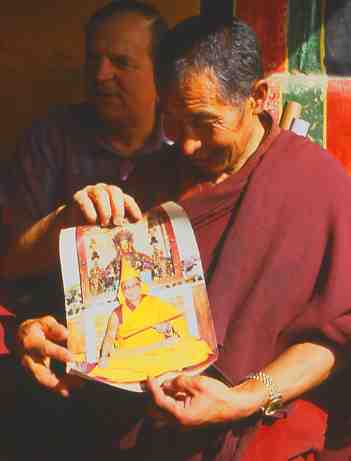
In the picture at left, our American guide and a monk at a monastery in Tibet -- I won't say which one, and I've cropped the faces so neither man can be identified -- hold a Dalai Lama picture that our guide presented to the monk. I can tell you that in the uncropped version, the monk is wearing a smile four miles wide. Everywhere we went in Tibet people would whisper, "Dalai Lama pic? Dalai Lama pic?"

When I consider this photo -- and especially the uncropped version showing the recognizable participants standing in a crowded courtyard openly beaming at the image -- I shudder. How could our guide have been so stupid? Tibetan monasteries contain monks (rather, some Tibetan monasteries contain monks...), and they also contain people charged with keeping an eye on the monks and their activities. To say that our guide put this monk at risk is an understatement. Before we left the States, our tour company warned us repeatedly not to pack or bring any pictures of or items relating to the Dalai Lama. We might be detained for possessing such items, and we'd put anyone to whom we offered them in harm's way.

I want so much to take a picture of the Dalai Lama on Saturday. But I'll content myself with sitting in row 34, eyes and ears transfixed on the live man and his message. It will be amazing, uplifting. Perhaps life-changing.

www.LoriHein.com

March 19, 2009

There shall be no ... in the Jokhang square

"Even today," said the Dalai Lama recently, "Tibetans in Tibet live in constant fear." The Tibetans' spiritual leader was describing conditions in his homeland 50 years after the 1959 Tibetan rebellion against Chinese occupation, which began with the 1950-1951 Chinese army invasion of Tibet. (Please click on "Tibet" in the "Where Do You Want to Go?" sidebar for posts about the situation in Tibet and links to sites with a wealth of information about the occupation, the Tibetan government-in-exile and the bleak prospects for the survival of Tibetan culture.)

I had a flashing moment of fear when I took this photo of a sign posted in front of Lhasa's Jokhang temple, Tibetan Buddhism's most sacred place of worship. Had a Chinese police officer seen me raise my camera to this announcement, he likely would have marched over to have a chat with me. Perhaps I would have been "punished with education."
www.LoriHein.com

November 25, 2008

Wampsutta, monkey meat and other Thanksgiving thoughts

Unless you're a Native American, Thanksgiving is a happy feast day. In Plymouth, not far from where I live, there's food and celebration. But if you look deeper, you'll also find members of the Wampanoag tribe gathered for their National Day of Mourning, held since 1970 when Frank James, a Wampanoag known as Wampsutta, was disinvited to speak at a Thanksgiving dinner when organizers discovered his speech was about the real history of relations between the so-called pilgrims and the native people whose land they landed on. Read James's speech here. No mention of turkey or fixins'.

Thanksgiving. Giving thanks for the blessing of being able to get together with others to buy, cook and eat way too much food, store it as leftovers, and, a week later, figure out what to do with the still uneaten remains. (Pitch it. If you freeze it, it will still be there next Thanksgiving.)

Allow me to use Thanksgiving as a segue into a travel post by sharing with you some of the things I've eaten around the world: monkey stew in Peru; yakburgers in Tibet; boiled, mashed manioc root softened (I swear) with human spit in the Amazon; roasted guinea pig in Ecuador; octopus in Greece; rotten black eggs in Hong Kong; gelatinous green yolk balls in Taipei; tea brewed with coca plant leaves in the Andes.

OK, I didn't really eat the manioc mess -- I pretended to take a taste as the bowl was passed around -- it was probably still full when it returned to the hands of the Yagua Indian woman who'd made it. But all of the other dishes were at least marginally palatable. Some, like the monkey and guinea pig, were culinary treats.

I can't say that for the eel chunks in broth that I was served on a train from Hong Kong to Guangzhou. And positively foul were the snake bits I found hidden in half the dishes on nearly every lazy susan set in the middle of the table in most big-city Chinese restaurants. The Chinese habit of sneaking slices of slithery serpent into my food made me turn to the Power Bars and canned beans and tuna I had in my suitcase. Otherwise I might have starved.

www.LoriHein.com

April 10, 2008

The race for Tibet: Saving Shangri-La


When a country bids to host the Olympic Games it says, de facto, that it wants the spotlight, that it welcomes the eyes, ears and attention of the world.

China got the Games -- and the spotlight. And the glare is harsh. As it should be.

On the roof of the world, a relative handful of Tibetan monks and nuns have succeeded, at a cost almost certainly to be paid with many of their lives, in sending out a global SOS. If the world's free people don't or can't use the upcoming Beijing games as leverage to force China into halting the gradual, systematic obliteration of Tibetan religion, culture and freedom that began with its 1949 invasion of Tibet, we may not hear from Tibet, the true Tibet, again. This may be the last call.

If you have the time, please visit the websites listed below for an overview of Tibet's 2,000 years of rich, independent culture centered on peaceful Buddhist principles; its last 59 years of repression under Chinese occupation and rule; its religious and political leader-in-exile and Nobel Peace Prize winner Tenzin Gyatso, His Holiness the 14th Dalai Lama; the Tibetan government-in-exile in Dharmsala, India; and organizations dedicated to helping free Tibet from Chinese oppression:

International Campaign for Tibet: http://www.savetibet.org/


Official site of the Tibetan government in exile: www.tibet.netTibetan Centre for Human Rights and Democracy: www.tchrd.org

The Beijing Olympics and The Race for Tibet: http://www.racefortibet.org/


Official site of His Holiness the 14th Dalai Lama of Tibet: http://www.dalailama.com/


Spend some time on these sites, and you'll begin to feel the uniqueness of Tibet in our world. We can't lose it. For a more in-depth look at Tibet and Tibetans since the Chinese takeover, read John Avedon's 1997 book, In Exile from the Land of Snows.


The Dalai Lama no longer has hope that Tibet will again be a sovereign nation. He is a 72-year-old realist who knows that he is Tibet's -- and the world's -- last Dalai Lama. His goal now is to save his people's culture and restore their freedom. What he wants from China at this point, after a half-century of quiet struggle, is a peacefully negotiated agreement that will give Tibetans a measure of autonomy and self-rule within the Chinese state and essential human freedoms of religion, expression and movement.

The Dalai Lama has already laid out a roadmap for the governance of that freer Tibet, a society based on the Hindu/Buddhist/Jainist principle of ahimsa, a Sanskrit word that means no violence. The Dalai Lama has lived and led by ahimsa, non-injury toward all, and his vision for future Tibet calls for, in part and in his words (read his entire governance plan here):

"Nature of Polity


The Tibetan polity should be founded on spiritual values and must uphold the interests of Tibet, its neighbouring countries and the world at large. Based on the principles of Ahimsa, and aimed at making Tibet a zone of peace, it should uphold the ideals of freedom, social welfare, democracy, cooperation and environmental protection.

Fundamental Principles of the Government

The Tibetan Government will observe and adhere to the United Nations Universal Declaration of Human Rights, and promote the moral and material welfare of its citizens.

Renunciation of Violence and Military Force

Tibet will be a zone of peace, based on the principles of nonviolence, compassion and protection of the natural environment. Tibet will remain nonaligned in the international communities and will not resort to war for any reason. "


I took the photos displayed in this blog post when Mike and I visited Tibet in 1987. Even then, before the wholesale transfer and migration of Han Chinese into Tibet accelerated the eradication of nearly all things Tibetan, I knew I was documenting a way of life that was perched on a precipice and about to be pushed off into the void. Even then, the sense of fear and loss hung heavy.

I can only imagine how heavy it hangs today.

www.LoriHein.com


November 30, 2007

On Top of the World


Eureka. I fixed the blog. Took only a week of my life.

I hope you like the new design and the new sidebar that lets you easily cruise stories by clicking on a country name. (My work as blog doctor isn't quite finished -- I still have to restore the RSS feed buttons. A glass of cabernet might give me some ideas...)

But I'm feeling good. On top of the world, even. Which reminds me of a travel story.

That's the real top of the world,
Mt. Everest, in the photo. It's not a bad photo, but it's not as good as the one that got away.

Mike and I were in Kathmandu,
Nepal, and we had tickets for one of the Everest flight-seeing tours that take off, weather permitting, early each morning. The day we were scheduled to go, the Everest flights were cancelled due to extreme wind, and we were told to come back to the airport the next day to see if the weather and our luck would change.

When we arrived under thick, gray skies at 6 AM, no flights were leaving. The agent at the Royal Nepal Airlines counter told us to relax at an upstairs cafe from where we could see the giant departure board hanging on the terminal wall. "If your flight shows a departure time, come immediately to the gate. The plane will board and take off quickly." When the mountain gods open a clear window of opportunity, you make your move before they close it.

Just before 8 AM, we watched numbers drop into place in the slots next to our flight listing. We were going. In five minutes. We slapped some rupees on the table to pay for our Nescafe and hightailed it to the tarmac.

As we took off, the day lightened, the sun burned through the fog and sent it packing, and the sky turned a blue that was a cross between cobalt and cornflower. The next 90 minutes were utter majesty, and the heart-stopping grandeur of the Himalayas sitting right outside the window of our 14-seat prop plane canceled out the heart-stopping fear of being in a 14-seat prop plane with the Himalayas sitting right outside the window.

I burned through rolls of Fujichrome. These were Earth's highest mountains. I felt humbled by them. And blessed to lay my eyes on them. These were mountains I'd read about all my life in first, my grandmother's, and then my own, National Geographics. I knew their names and their snowy, stony profiles. I recognized and named them as we flew past: Gauri-Shankar; Melungtse; Cho-Oyu; Nuptse; Lotse; Ama Dablam; Makalu.

My Nikon purred, and I clicked off frame after frame. When Everest appeared, I shot what was left of the roll I was working and loaded a new one. Just after the roll was loaded, Mike and I were tapped to come up to the cockpit. Hard to believe, but Everest flight passengers are invited, by turns, to spend a minute or so in the cockpit with the pilot. The pilot names and discloses altitudes of the peaks filling his windshield, and, although he does this perhaps a hundred times a week as each open-mouthed tourist on all of his flights enters the tiny instrument-filled sanctum to gaze on the top of the world, he does it reverently. He loves and honors these mountains,
sacred to both Buddhists and Hindus.

Mt. Everest straddles the Nepal-Tibet border, and in her people's cosmology, she's the Mother Goddess of the Universe, called Sagarmatha in Nepali, Chomolongma in Tibetan.

Everest was outside the window as we walked to the cockpit, and as we entered the pilot banked the plane to begin the turnaround back to Kathmandu. The flight route was up the Himalayan spine to Everest, then back down the spine to Kathmandu. As the pilot turned the plane, he flew straight toward Everest, and we were the ones in the cockpit at that incredible moment. Mt. Everest filled the windshield.

I raised the camera and clicked the shutter. Nothing. Frozen. Everest was full in my face, and my Nikon, which had been around the world with me several times over and had never failed me, was dead.

I looked out the windshield and sucked in every inch of Everest I could get my eyes on, hoping I could imprint her face and summit and every one of her cols and crevasses forever in my mind.

Our cockpit visit ended and we went back to our seats. I lifted the Nikon and pushed the button. Click. Frame advance. The camera performed like a star for the rest of our journey.

My Nikon and I have been together for 30 years. The only time she's said, No, I won't capture this for you, was when she came face to face with the Mother Goddess of the Universe.

March 02, 2007

Tatopani: Beautiful yellow things

We'd been traveling across the Tibetan plateau for over two weeks. Tibet, the rugged roof of the world, is one of Earth's most fascinating destinations, but travel there is physically punishing. Tibet fills you up. And saps you utterly.

Our journey was ending, and everyone in our small tour group looked forward to crossing the border into Nepal. Kathmandu held the promise of hot food and hot water, and we dreamed of these. We'd savored our trek across Tibet, but we were spent.

Tibet had dealt us a deck of broken roads, landslides, rabid dogs, power failures, lengthy document checks by Chinese officials, hotel water that ran for two hours a day (you had to guess which two...), monotonous canned meals of mandarin oranges and stewed tomatoes pulled from cardboard boxes stashed in the back of our bus -- we'd suck down every drop of liquid to relieve our dehydration and take in every available gram of vitamin C. We couldn't count the times we'd helped our driver, Pinzo, with his shock of thick black hair and huge, patient eyes, push our vehicle out of mudholes and swollen streams and flooded roadbeds, and we couldn't remember the last time we'd bathed.

At Zhangmu, Tibet we made our way down a mountainside to the Friendship Bridge that links China to Nepal at Kodari. The hike was too steep for a few older members of our group, so they hired nimble-footed porters to carry them across the border on their backs.

Our itinerary called for a bus to meet us in Kodari and take us to a site where helicopters would ferry us over a severe, wide landslide area, completely impassible by road. Once over the slide, another bus would meet the helicopters and take us to Kathmandu. That was the plan.

Plans go awry. Our minimally competent guides had spent most of their energy on the journey squabbling amongst themselves and had forgotten to call the helicopter dispatch office to announce our arrival in Nepal and confirm the helicopter pick-up. We sat on a mountaintop near the landslide area for three cold hours, until the sun began to inch below the hills, waiting for choppers that the guides delayed admitting were never coming. We would end up walking over the slide the next day, a grueling, waterless, foodless debacle that would take 10 hours.

But first we had to find somewhere to spend the night. We were driven up a steep, cliffside dirt road to Tatopani, Nepal and left in the middle of the town's dusty main strip. Trekkers on Nepal's Annapurna climbing circuit use Tatopani as a rest stop, and when we arrived there weren't any rooms left in the town's few basic lodges. We were filthy, frustrated, parched, hungry and exhausted, and there was no room for us at the inn.

As we began wandering the main street, cursing our luck and wondering what to do with ourselves, the village of Tatopani embraced us.

First, a handful of farmers, herders and merchants offered us space in the lofts of their wooden houses. They led us to their homes, rolled crude mats onto straw-covered plank floors, and told us we were welcome.

After we'd all laid claim to a mat somewhere, we gathered in the street. We hadn't eaten since morning, so we made plans to buy and share whatever we could find on the shelves of Tatopani's few tiny shops.

As we prepared to fan out to find food, a man called to us from the stone stoop of a narrow wooden house. He opened his front door and windows wide and invited us all inside. The man had transformed his home into a makeshift restaurant, just for us.

As he showed us to tables and benches he'd set up in his front room, his wife was cooking something hot and wonderful-smelling in a kettle that hung on a tripod over a wood fire in the kitchen. Steam that hung heavy with a rich, vegetable aroma billowed from the pot. A few minutes after we sat down, the woman began delivering platters of deep yellow skinless, boiled potatoes and bowls of salt to each table.

Warm and butter-colored, with a velvety mouthfeel. Coated with chunky salt. Eaten with dirt- and sweat-creased fingers under the smoke-blackened rafters of a tiny house that clung to a Himalayan hillside. The Tatopani potatoes were the finest meal we'd ever had.

Sated to our bones, we thanked the family, left some rupees to help cover the cost of what had been shared with us, and moved outside. At this point, everyone in the village knew about us and our unplanned overnight stay, and a group of children, some with tiny brothers or sisters in bundles on their backs, waited in the street to inspect us.

One of our fellow travelers reached into his pack and produced a bag of yellow balloons. As he blew them up, the children moved closer, and their cautious curiosity turned to grins and laughter. Within a few minutes, nearly every kid in Tatopani held a yellow balloon.


www.LoriHein.com

July 07, 2006

Happy Birthday, Dalai Lama

I wasn't planning to post today. I just finished an article on deadline and was looking forward to a day or two of writing absolutely nothing. And, OLN's Tour de France broadcast starts in 25 minutes.

But I just heard on the radio that today is the Dalai Lama's 71st birthday, and I couldn't let the day pass without wishing one of the planet's kindest souls and gentlest peacemakers a happy birthday.

Wherever we went in Lhasa and across Tibet, people would whisper, "Dalai Lama pic?" hoping we westerners had tucked a forbidden photo or two of His Holiness in our backpacks. We, the tourists, hadn't. We'd been ardently advised not to in the travel documents provided by our tour company. Attempt to enter China with photos or writings about or by the Dalai Lama and prepare to potentially spend a whole bunch of time in a cold cell was the message.

So we left our Dalai Lama pics at home. But our tour guide hadn't.

He stunned us when, at a monastery outside Lhasa, after a gaunt monk in a crimson robe peered around a painted pillar and uttered a hushed but hopeful "Dalai Lama pic?", he produced one and handed it to the monk. I shot a photo (which I'd inserted in this post then deleted, knowing this blog is read in China) of the guide giving the glorious contraband to the monk, and I held my breath from that moment until we crossed the Nepalese border two weeks later, knowing that if, for some reason, my film were seized and developed, the guide and I might go to jail. And the monk might die.

When we got to Kathmandu, I bought a bright red t-shirt with an embroidered Tibetan flag on its front, under the words, "FREE TIBET." We'd been in Kathmandu two days when I picked up a newspaper and read that, the very day we'd crossed the Tibetan-Nepalese border, two 20-something Americans had been arrested in Lhasa's Barkhor Square and imprisoned.

Their crime? Wearing "FREE TIBET" t-shirts.

www.LoriHein.com


June 24, 2005

Shangri-La Express: Slow train to Tibet


Have a spare 17 grand that’s been burning a hole in your pocket? Book a berth on the Shangri-La Express, due to roll from Golmud, China to Lhasa, Tibet beginning in 2007. For $16,995 single occupancy, you can take a deluxe International Railway Traveler Society rail tour of China that begins and ends in Beijing and includes a 20-hour ride on the 713 miles of track the Chinese government is currently constructing to link Golmud with the fabled Tibetan capital. (The UK’s Trans-Siberian Express will operate the train, and National Geographic Traveler magazine reported that tours starting at $5,600 are available through the operator’s booking arm, GW Travel. That may be, but in this blog, I link you only to sites that pass the Lori Hein test, and gwtravel.co.uk, didn’t. Once on the site, a look at their price list requires a download, a step I didn’t appreciate. If you’re interested, you’ve got the URL.)

When completed, the tracks between Golmud, in Qinghai Province north of Tibet, and Lhasa, will be the world’s highest railway line. For most of the journey, passengers will roll along at over 13,000 feet, topping out at 17,146, and pressurized cabins will mitigate the effects of the low-oxygen environment. (Effects like brain-piercing altitude sickness headaches. Mine reduced me to a weeping pile of flesh, and I ate painkillers and sucked on the hose of the oxygen bottle in my Lhasa hotel room to no effect. I waited it out, all the while thinking my head would surely explode and I would die on the floor of the Lhasa Holiday Inn.)

The advent of the Shangri-La Express is remarkable not only for the wonder of its engineering, but because it will make more accessible a place that has, for ages, been among the world’s most difficult to reach. And it’s Tibet’s remoteness that has helped protect and nurture its gentle 1400-year-old Buddhist culture and has given the land its powerful aura of mystery.

This train to Shangri-La is a watershed railroad. A turning point that signals a point of no return for Tibetan culture and no hope of independence from Chinese occupation. In 1958, seven years after they invaded Tibet and a year before the Dalai Lama fled to exile in Dharmsala, India, the Chinese began construction of the Xining-Golmud section of a planned Qinghai-Tibet Railway. That first link opened to traffic in 1984. The Golmud-Lhasa stretch is the final link in the chain. By laying track through Himalayan plateaus and sacred peaks, landscape heretofore considered virtually impenetrable, and establishing a Chinese rail terminus in Tibet’s ancient capital, the Chinese make a statement: Lest anyone still doubt, Tibet is not merely linked to China, it’s chained.

Now for the upside. I’d choose a 20-hour luxury train ride to Lhasa over the two and a half-hour white-knuckle flight Mike and I took from Chengdu to Lhasa any day of the week. Chengdu, in Sichuan Province, is the key air gateway to Tibet. Starting in 2007, Golmud, which is a road gateway, will also be a rail gateway. It’s nice that travelers will have a choice, because our flight was one of the four scariest of my life. (The others? Fodder for another post...)

We took off from Chengdu. The CAAC flight attendants were getting ready to distribute sad little passenger “box lunches” when a voice announced that the plane had “mechanical problems” and we were returning to Chengdu. One of the four engines had shut down. We circled Chengdu, the pilot using the Chinese flying techniques that had been scaring me to near-death on every flight we’d taken in the country. I was sure we’d never see Tibet. We were going down, our quest for Shangri-La doomed to end in a Sichuan vegetable field.

We landed, I kissed the tarmac, then we sat in the Chengdu terminal for two hours. We talked with some businessmen who’d earlier taken off from Chengdu for Chungking (Chongqing), a 40-minute flight. They’d gotten all the way to Chungking but couldn’t land due to fog at Chungking airport. So, the plane flew back to Chengdu, where passengers and crew sat waiting for the fog to lift so they could try again. Fog talk. An ill omen, I thought. I knew the Chengdu to Lhasa flight wouldn’t leave if there were but a hint of fog in Lhasa. Each moment spent repairing our engine gave the elements more time to blow fog toward Tibet. Hurry up! No, never mind! Don’t hurry up! Take your sweet time fixing that engine, and please do it well! I was a bundle of nervous emotion.

We took off again. I was flying to Lhasa, Tibet, the Roof of the World, a place I’d dreamed of seeing since I was a kid devouring copies of my grandmother’s National Geographic. That I was on my way to this fabled place was blowing my mind, but as much as I tried to relax and let the glorious anticipation wrap around me, I couldn’t help fixating on the engine outside my window. Was that the one that had blown? Did they really fix it? Would it die again, causing the insignificant plane to smack into a 20,000-foot ice-encrusted Himalaya? And the pilot. The guy used reverse thrust and other techniques that felt horribly alien. He was going to land us between Himalayas on a short strip of tarmac at the world’s highest airport? Whoa, baby. Never mind the box lunch. Get me a cognac.

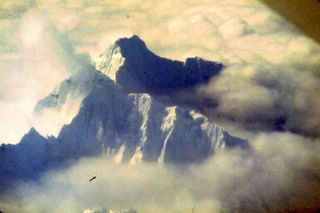
About two hours into the flight, on the plane’s left side, a scene of unparalleled beauty revealed itself. We were some 7,000 feet above the highest peaks of the Qionglai-Minshan Mountains (see post below), an eastern range of the Himalaya. My fear and anxiety found new partners, awe and wonder, when I saw what I believe was 24,790-foot Gonga Shan (Minya Konka in Tibetan) – if not her, a near neighbor – pierce the clouds and seemingly rise to meet the plane. Terrifyingly beautiful. Overwhelming, brutal, magnificent.

The sea of glorious peaks we flew over separate the Sichuan Basin from the Tibetan Plateau. A staggering, powerful, vertical white wall that heralds and holds back the magic that is Tibet. Part of this landscape is Kham, (Chamdo in Mandarin), land of strong, quiet horsemen. Part of this landscape was traversed and explored by Joseph Francis Rock, a botanist and adventurer who led the 1927-1930 National Geographic Southwest China-Tibet expedition. His photographs, many of which were published in National Geographic, are a window to the true Shangri-La. That Rock penetrated such a remote piece of the planet to study plants, geography, people and culture still amazes, and in preparing this post I found a wonderful blog by a present-day Rockphile. Click and enjoy.

We cleared the high Himalaya. I exhaled. We neared Lhasa. I inhaled. I girded myself for another strange Chinese landing, and the pilot obliged by delivering a horrible gut-girding reverse thrust maneuver, then practically diving for the tarmac. Hey, this isn’t a helicopter, pal. I dug my nails into Mike’s arm and prayed we’d live long enough to see the Potala Palace (above).

Next time, I’ll take the train.
Flying to Tibet over the Qionglai-Minshan, a range of the eastern Himalaya. The peak in the foreground may be 24,790-foot Gonga Shan (Minya Konka in Tibetan). Posted by Hello

May 06, 2005

Tibet: Who let the dogs out?


My daily runs are usually enjoyable experiences, but close encounters of the canine kind can ruin things. I had a dog experience a few days ago, one that sent me to the police station to file a complaint. A husky atop a picnic table on a backyard deck built high above a yard and encircling fence saw me coming, leaped over the fence into the street and held me hostage for ten minutes. This was the third time I’d met this beast on my favorite route, and all the cardio goodness I got from my run evaporated as I blew my top and blood pressure while keeping Mr. Fang from my calves and thighs. (Hey, dog, I need those!) The neighbors who watched but couldn’t help yelled perversely encouraging things like, “So many people have reported this dog!” and “This happens all the time!” and “The owner is a Boston cop, but he doesn’t do anything about it.”

I’ve been pawed, clawed, sniffed, jumped on, growled at, held at bay and bitten by loose dogs whose owners often stand nearby watching the action but taking none. I’ve had my clothes torn, and I’ve been to the ER to confirm the age and protective power of my last tetanus and rabies inoculations. “Don’t worry.” “He’s friendly.” “ He won’t bite.” “He’s more afraid of you than you are of him.” “He’s never hurt anyone.” Oh, had a dime for every time I’ve heard such words.

The dog encounter that most sets my head to shaking was the morning I ran around the dirt roads in the New Hampshire development where we have a cottage and was stopped dead (happily, hyperbole) by two canines, teeth bared, who bolted down their driveway and kept me prisoner in the middle of a considerable hill. I screamed for the owners to come out of the house. They eventually did. (Minutes seem like hours when mouths dripping saliva hang a few inches from your shins and sidequarters.) A mom and two kids ambled, moon-eyed, to the end of the driveway where they stood as a unit and stared at me. They did and said nothing, until the mother finally mumbled, “You’re getting them excited. If you’d just stop running, they wouldn’t come after you…” The three humans stood motionless and watched their animals growl and lunge whenever I made a move to leave. We stood in this stalemate until the dogs got bored and loped back down the driveway.

But this is nothing compared to the dog dread I felt while in Tibet. There, mongrel dogs are everywhere, but they appear in particular abundance at monasteries. (Or, more accurately, ruins of monasteries, as the Chinese, having invaded Tibet [they don't call it an invasion] in the 1950s, successfully obliterated most Buddhist monasteries, epicenters of Tibetan life, during the horrific years of the Cultural Revolution. The Chinese have partially rebuilt some of the temples and monasteries and repeopled them with enough monks to keep them operating as "museums" and tourist attractions.)


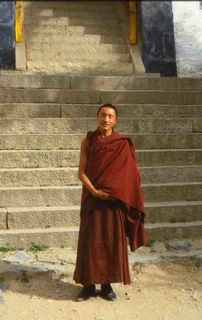
At Sera Monastery outside Lhasa, where monks sit in groups in the treed courtyard polishing their debating skills, a horde of dogs swarmed our vehicle when it pulled into the parking area. As we explored Drepung Monastery , "Rice Heap" in Tibetan, (a Drepung monk in above photo), which hangs on a high hillside outside Lhasa, dogs followed us up and along the warren of dirt paths and alleys that ran through the complex of temples, dormitories and chanting halls.

And there were more dogs in Xegar, a dusty outpost that is a gateway to Mt. Everest. This is a verbatim entry from my journal, written in Xegar’s Everest Hotel (a concrete gulag – I’m low maintenance and extremely easy to please, but this was bad): “Last night I barely slept. Dogs were running wild through this compound all night. There are more dogs in Tibet than you could ever believe. They hang out in massive profusion at monasteries because they get food there. The monks feed them because they believe dogs are reincarnated monks who failed to return to a higher plane. At 4 a.m., I went outside our cell (“suite,” the tour operator called it) to go to the bathroom (a pit latrine), and, as soon as I stepped down the three steps to the dirt yard, two wild dogs tore by my legs. I was scared to death.”

The morning after I wrote that journal entry Mike and I hiked up a mountainside outside Xegar and came to what the Chinese had left of the 800-year-old Shining Crystal Monastery, a walled citadel tucked away on the high reaches of a slope overlooking the beautiful, light aqua river that runs between the last mud-walled houses at the back of the town and distant yellow mustard fields under cultivation. As we climbed, the river pulsed and rippled over mounds of smooth, rounded stone.

We thought Shining Crystal, which once housed 400 monks, was abandoned. It was a shell of what it once was, and we expected to have the striking, firebombed ruin to ourselves. We were at serious altitude, which made us feel even more alone. We were startled, then, when we puffed up the last piece of dirt trail and heard laughter.

Above us, on an ancient, deep red stone arch that framed the mountain trail, sat a half-dozen boys in maroon robes. Little monks. They smiled, swung their feet back and forth in the air and beckoned us to enter. As soon as we crossed the compound’s threshold, dogs appeared. They barked viciously and showed their yellow teeth.

Saved by the monks. The cherub monks shooed the dogs away and then, with great smiles, led us through the passages and warrens and alleys and chambers of the monastery. They showed us everything that was left, everything the Chinese hadn’t disintegrated. We gave the boys pens, hard candy and a few yuan. (They wanted pictures of the Dalai Lama, beloved secular and spiritual leader of all Tibetans, living in exile in India since his escape from Tibet at the time of the Chinese invasion. "No Dalai Lama pics," I said sadly. I’d made a conscious decision not to bring those into Tibet because I didn’t want to be arrested. I applaud passionate activists like the forever-blacklisted-from-China Richard Gere, but I, a weenie, waited until Kathmandu to buy my bright red “FREE TIBET” t-shirt. Just days after we returned home, newspapers ran stories of two Americans who’d been arrested in Lhasa’s Barkhor Square for wearing “FREE TIBET” shirts. Dummies, I thought. You did things backwards. See Tibet first, then buy “FREE TIBET” t-shirt in Nepal. Wear it on the plane home. Make a statement, but stay out of Chinese jail.)

Shining Crystal’s boy monks brought us into the monastery’s main hall, full of images of Tibetan spiritual leaders Dorje Chapa and Songsten Gampo. At the holy chanting hall, where monks young and old were gathered in meditation, Mike was invited to enter, but I, a female, had to remain outside. Mike took his shoes off and went into the deep, close space. I stood at the chanting hall doorway and breathed in the scent of burning yak butter as it escaped in wifts from the sacred, oblong chamber.

Chanting concluded, Mike and the monks emerged from the dark room. Mike put his sneakers back on, and we bowed and touched our fingertips in the universal salaam of friendship and respect, then turned to leave.

On a rock wall above our heads, dogs, growling viciously, shadowed us. We moved, they moved. These beasts would, it was clear, pounce on and eat us before we reached the gate that led back to the world below the Shining Crystal Monastery.

I’d had enough of dogs. Traveling overland across Tibet required considerable endurance, and I was hard pressed to waste any of my remaining energy on dogs. I turned toward the chanting hall threshold in total and complete supplication. An old monk stood in the doorway, and I asked him with my eyes to help us. No words were exchanged, but the spry old guy hopped up onto the wall and, with his arms, kept the canines frozen in place atop the wall until we’d safely exited.

We scrambled down the slope toward Xegar. When we were out of sight, the old monk probably fed the dogs, his yet-to-be-optimally-reincarnated fellows. “I’m sorry,” he might have said. “They’re not all like her. And be patient. Your next lives will be better. Om mani padme hum. Hail to the jewel in the lotus."


Support a monk

Support a writer


November 05, 2004

Border run: Zhangmu, Tibet to Kodari, Nepal


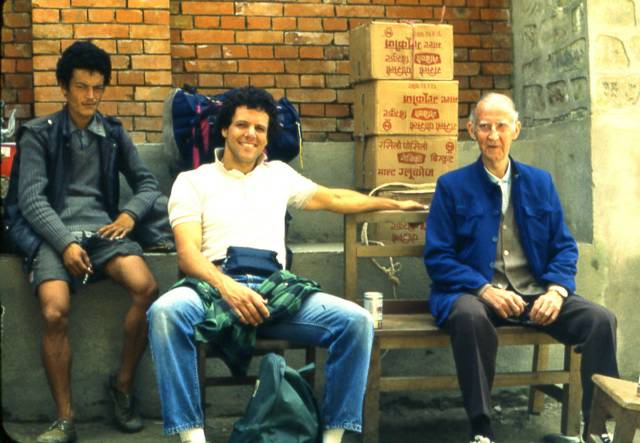
Why is Clarence from Calais, Maine smiling? Because 86-year-old Clarence, right, was the first person in our group to make it down the rocky, precipitous two-mile border crossing between Zhangmu, Tibet and Kodari, Nepal. Mike and I (that's Mike in the middle) came in a close second. We waited 4 1/2 hours for everyone in the group to negotiate the killer crossing. And how did 86-year-old Clarence beat us? He was carried by two Nepalese porters, who switched off. They hoisted Clarence onto their backs, piggyback style, and took off running down the cliffside. There was more than one switch-off that made me look away and pray. The porters hoisted Clarence onto their backs with so much power that I honestly thought he'd go flying over their heads and be hurtled into space. Clarence occasionally looked concerned, but generally had a ball. Just what you'd expect from a near-nonagenarian who vacations in Tibet... That's one of Clarence's porters on the left enjoying a well-deserved post-workout cigarette.