Showing posts with label England. Show all posts

December 06, 2010

Kate and William's Westminster wedding: Sightseeing tips

Next year on April 29 Prince William and Kate Middleton will tie the knot in London's Westminster Abbey, site of British royal weddings, burials and coronations going back to the crowning of William the Conqueror, Duke of Normandy, as King of England on Christmas Day 1066.

Those invited to the regal nuptials will experience not only the pageantry of the event but also the spectacular interior of this thousand-year-old Gothic masterpiece.

If your invitation gets lost in the mail and you have to visit Westminster Abbey on your own, not as an honored wedding guest but as a common tourist, a ticket will set you back 15 British pounds, about 25 bucks.

You'll face long queues, strict visiting times and prohibitions against photography and brass rubbing (head to St. Martin- in -the- Fields for that), but the soaring space and overpowering feeling that hundreds of the afterworld's most celebrated ghosts are walking or floating next to you render moot any administrative inconvenience.

One of my favorite rooms in the world is in Westminster: the Chapter House.

I visited back in the days when entry was free, there were no lines, you could buy paper inside the church and rub brass plaques and grave markers to your heart's content and shoot pictures until you ran out of film or flashbulbs. (Remember those?)

After I shot this photo of the Chapter House, an octagonal stone room rich with sculpture, stained glass, wall paintings and a medieval tile floor so smoothly polished that the sun paints a second set of colored glass windows across its entire expanse, I sat on one of the benches built along the room's perimeter and imagined the people who'd sat on these benches centuries before me.

The Chapter House was the business end of the abbey, so to speak. Monks gathered here to pray then discuss and plan their order's mission, tasks and daily work. In 1257 the King's Council, a precursor to Parliament, met in this room, and the early body of the House of Commons sat here, too, before moving to the great, gothic Parliament building just around the corner from Westminster. The abbey's great nave and lacy chapels hosted pomp, circumstance and services to feed the spirit, but the Chapter House was where the nuts and bolts of running an organization, and a nation, were hammered out.

If you get inside Westminster, whether on April 29 or some other date, don't miss sitting awhile and communing with the ghosts of the Chapter House.

www.LoriHein.com

October 26, 2010

Cornwall: In search of underwear

My yoga class isn't the perfect-poses-in-serene-silence kind. Our happy group does a lot of talking and laughing while executing our bridges, downward facing dogs or reasonable facsimiles. If a new person who appears to be a serious practitioner comes into the room we warn her (Walter's our only him to date) that ours is a pretty casual class and that we can get rambunctious.

Today we discussed underwear, or the lack thereof.

Joan started it off with a story about her grandson, who'd recently stayed at her house overnight. Joan's son came in the morning to pick up his son and said to him, "Make sure you put on clean underwear," to which the kid admitted he'd forgotten to pack any. So dad told him to put on yesterday's underwear. "I forgot to pack yesterday's, too," was the reply.

As we guffawed our way through some triangle poses, Sara picked up the thread and told about the day her son, who eschewed underwear despite his mother's pleas, changed his commando ways when an urgent, unplanned visit to the pediatrician left him, well, blushing in the exam room.

Linda recalled the day she was substitute teaching and was on recess duty with a group of third graders. One little girl in a dress had no underwear on, so Linda took her to the nurse, who called the girl's mother. "I have six kids!" she said. "Some days I just can't check everything!"

"Are you taking all this in, Lori?" asked Anne, the instructor. We often joke that the things we talk about while pretending to do yoga make good fodder for stories and articles.

"I sure am," I said. "I'm lying here writing a blog post in my head."

I was already thinking about my own underwear story. A travel story, of course:

We'd landed in London where we rented a car and drove to Cornwall for a week's stay in Polperro, a stone fishing town with a lively harbor and a dramatic setting behind and atop high, green headlands.

On the second day of the trip I discovered I'd packed only one pair of underwear. So, I had two: the ones I'd flown across the Atlantic in and the ones in my suitcase.

No problem, I thought. I'll just buy some. And I did. Five days later.

There was no underwear in Polperro. There were clotted cream and jellied eels, doilies and seagull statues, sun umbrellas and sand pails. No underwear. I looked in every shop; none carried undergarments of any kind. I would have bought men's had they been available. At this point, the underwear's gender mattered not a whit. If it fit my butt, I'd buy it.

So, I began a ritual of washing my personals out in the morning and hanging them in the sun to ensure they'd dry by the next morning, when I'd swap out my gear and wash the other pair. It became tedious very quickly.

As a family, we began an earnest search for underwear for mom. Each day we'd take to the road to explore new hamlets and villages and seaside resorts, always on the lookout for any place that looked like a promising potential underwear source. For five days, we searched in vain.

There were no knickers in Polruan or Bodinnick, St. Austell or Mevagissey, Feock or Cripplesease. No skivvies in Duloe, St. Just or St. Veep.

On day five we headed into Looe for Looe Carnival Week, which features a kids' crab-catching contest. After watching scores of kids lined up along the quay bait their lines with fish and toss them down into the harbor estuary 12 feet below the quay and chatting with the family that was clearly going to win the contest -- three crabbing kids and a plastic bin overflowing with 260 crabs at last count -- we headed to the main street to shop for souvenirs.

In a cramped shop stuffed with tourist geegaws, I saw a marvelous package: a plastic bag containing not one, but five pairs of ladies' underwear. One, single, precious pack of undies.

I grabbed them and rushed to the cash register where I thanked the owner for stocking underwear in his souvenir shop and gushed that I'd come all the way to England from America and had forgotten mine.

"Well, then," he said, as he smiled politely and took the pounds equivalent of six dollars, "you'll have a change tonight, dear, won't you?"

www.LoriHein.com

June 01, 2009

Jacket potatoes


The cupboard was pretty bare yesterday when I set about making my lunch, but I rummaged around and found a fat Russet and a small can of lima beans. I nuked the potato, split it open, poured the limas on top and was culinarily transported to England.

Foodwise, I find England a challenge. It's hard to maintain a healthy diet in a deep-fried kingdom of pub grub. I don't eat meat, so bacon and bangers and burgers are out, and I run away from anything batter-dipped and/or boiled in oil, so most everything else English is out, too.

In England, people start eating chips -- french fries -- at breakfast. Chips are paired with everything: eggs and chips; fish and chips; chicken and chips; sausage and chips; mussels and chips; pizza and chips... You can eat your chips sitting down or you can order "chips to take away," dripping grease and wrapped in a cone made from yesterday's newspaper.


In Polperro, a gem of a fishing village tucked into a secret corner of the Cornwall coast, I discovered the meal that would carry me through England: the jacket potato, so-named because the potato -- the meal's foundation -- is left unpeeled, then baked and served in its skin, topped with a filling of your choice.

As we made our way through southern England, Mike and the kids ate chips and whatever gross, greasy things the chips accompanied while I spent a grease-free week eating big baked potatoes topped with lovely stuff like cottage cheese, baked beans, peas and tomato sauce.

Yesterday, as I sat on my deck eating my lima-smothered potato, I imagined I could hear the seagulls and smell the brine of tiny Polperro and its beautiful harbor.

www.LoriHein.com

December 28, 2008

Tin, coal and gold: Journey down the family tree


Dana just did a geneaology project for her history class wherein she aired our family laundry, some nice, some not. On the not side lies great uncle George Fink, a card-carrying member of the National Socialist party who flew the Nazi flag from his Brooklyn tenement, to the great dismay of his neighbors. He met his death in a New York elevator shaft. There's no official homicide determination, but the word passed through the generations is that George was, shall we say, helped over the brink. "Sorry for your loss," said Dana's teacher.

But we had good folks, too. One of our ancestors was a deckhand on Horatio Nelson's ship during the Battle of Trafalgar. Nelson took a fatal blow, but our ancestor lived to beget a line that would include my grandfather, Steele Pille, who wanted to join the U.S. Navy at 16, but couldn't because he was underage. So he copped an alias and fake papers and overnight became 18-year-old Harry Doubleday (photo below). He spent World War II in France and Japan and rose to Chief Petty Officer. He only revealed his real name to his future bride, my grandmother, shortly before their wedding. "Your name won't actually be Mrs. Doubleday... You'll be a Pille..."
Steele Pille dba Harry Doubleday's father was John Delbridge Pille, a tin miner in Cornwall, England, who emigrated to the U.S. after Cornwall's tin lodes were exhuasted. He moved to Pittsburgh and mined coal. He developed black lung and died in a coal mine accident in Uniontown, Pennsylvania.

John Delbridge Pille (photo above) appears briefly in my book, Ribbons of Highway: A Mother-Child Journey Across America. I thought of him when the kids and I visited the Empire Mine in Grass Valley, California. An excerpt:


We got off the interstate and took Route 20, a single lane highway that would carry us most of the way across California. The highway changed with the elevation, taking us out of high wilderness down to where the land lost its mountains. It was first a National Forest Scenic Byway, with huge pines hugging the road and vast mountain vistas. Then, it was an artery feeding the huge agribusinesses of the Sacramento Valley. It ended as a winding meander past the string of laid-back lake towns that sit east of the Russian River, the Redwood Empire, and the Mendocino coast.

Latino pickers, wrapped against the sweltering sun in hats, face scarves, pants, long sleeves, and gloves, tended hot fields. Endless alleys of Diamond walnuts, almonds and pecans; strawberries and blackberries; peaches, plums, apricots and nectarines; tomatoes, peppers, cukes and avocados; lemons, melons, grapes and cherries; pears, sweet corn and sunflowers. The Sacramento Valley was wickedly dry, yet still bountiful.

Earlier, we’d detoured into the Gold Rush. The towns of Nevada City and Grass Valley overflowed with magnificent sherbet-hued Victorians, built by Cornish miners to resemble cottages back home. The hilly towns were nonstop eye candy, and I could have walked their streets for days.

At Empire Mine, 350 miles of underground passages and once California’s richest hard rock gold mine, we stood at the top of the slanted shaft and peered down a minute stretch of Empire’s 11,000 feet of total incline depth. Cold air from the bowels of the earth washed over us. Workmen from Gray Electric were in the shaft, building a simulated ride that the foreman explained “will make visitors feel like they’re hurtling down in the carts that brought the miners down.” It was to open at the end of the summer.

“Oh, man!” moaned Adam, lamenting missing this high-speed jolt down into a dark hole in the earth. “We should’ve come here in August!”

I would have liked to go down into Empire, too, not for the hurtling, but to listen to a mine’s ghosts. To hear in the empty tunnels and caves and niches the voices and labored breathing of men, the clink of axes picking slowly and ceaselessly at unforgiving walls of rock, the rattle of pony carts, the drip of water from stone. The grim underearth sounds of men wresting something people deem precious from brutal, sunless holes. Descending into a black mine only lets you begin to grasp the bleakness of a miner’s day and lifetime.

We’d gone down into an old coal mine back in Beckley, West Virginia, where I’d reminded Adam and Dana of their great-great-grandfather, John Delbridge Pille, a Cornish tin miner who’d come to America to mine coal outside Pittsburgh, not all that far as the crow flew from Beckley. Jim, who’d been a miner for 38 years, was our Beckley guide. His grandfather, father, sons, and grandsons had also spent years of their lives underground, working the soft coal of the Sewell seam. We’d traveled in converted coal cars on tracks, down and through the dank pitch of Beckley’s drift mine, nearly horizontal and far closer to the surface than the steep maw of the Empire, at whose entrance, 4,600 miles from Beckley, we now stood.

Jim had pointed out hand-hewn alcoves, some no more than three feet high, telling us to imagine stooping or lying on our backs, swinging a pick for eight hours to loosen the coal overhead. He’d talked of killers unleashed as men cut coal. Methane, released from seams that had held it for ages, exploded. Seeping poison gas displaced fresh air and killed quickly, creating deadly pockets called black damp. Canaries would succumb before humans, so if a miner’s bird died, the man knew he had but a few minutes to escape the area of fouled air.

Now, as I stood before Empire’s steep lip, I wondered if John Delbridge Pille, tin and coal miner, had known any of the Empire gold men. Empire’s success had been built in no small part on the skill and experience of Cornish tin and copper miners who’d left England at the news of California gold. Pille had left England for Pittsburgh about 1840, only a decade before Empire’s first Cornwall miners arrived. Maybe some of the men who’d worked a mile or more down in the cold hole we now stood at had once worked beside my great-grandfather, pulling tin from one of the mines whose stone wheelhouse ruins dot the Cornish landscape like crumbled industrial cathedrals.

www.LoriHein.com

May 23, 2008

Get me out of here! Tourists trapped

At yoga the other day our instructor, Anne, complimented the class on having attained a level of limberness that let us execute crunches on balance balls without rolling off and crashing onto the studio's wood floor. We students patted ourselves on the backs (a few of us literally, as further demonstration of our increased flexibility).

Over in the corner, Kathy commented that our workouts had also improved her lung capacity. "I went along on a field trip to the Bunker Hill Monument and climbed all the way to the top without getting winded. I was so excited!" She compared that visit with a previous Bunker Hill foray that had left her gasping for air on the narrow staircase that leads to the monument's observation deck and panoramic view of Charlestown and Boston's harbor and skyline. "The staircase keeps winding and turning, and people are coming down while you're going up. And there are no windows."

"Like the Statue of Liberty," said Lucia, unfolding herself from a perfect cat stretch. "I climbed up the Statue of Liberty once and got claustrophobia. Real claustrophobia. I had a panic attack. I was perspiring. I started crying. My son was five, and he didn't know what was happening." A fellow sightseer came to Lucia's aid and guided her to an open air platform where she was able to regroup and steel herself for the trek down.

I felt pangs of sympathy hyperventilation as Lucia recounted her clammy excursion into Lady Liberty's innards. I rolled around on my balance ball and thought about some of the weird, uncomfortable places around the world that I'd stood in lines and paid money to enter. Small, close places I'd have been better off viewing from the outside. High, dizzying places I'd have been better off contemplating from the ground.

The world offers the tourist many places to have a panic attack. Among them:


* Chichen Itza -- I had no problem with the steep climb to the top of the Pyramid of Kukulkan at this remarkable Mayan city in Mexico's Yucatan -- I even sat, smiling, in Chac the Rain God's lap for a rest and photo op when I reached the summit. But when Mike and I ventured inside the chamber behind a staircase at the structure's base for a look at the priceless jaguar statue it held, I freaked out. I imagined the entire pyramid collapsing on my head and pinning me inside the airless, unlit tunnel. A gringo sacrifice to the Mayan gods. I never reached the jaguar -- Mike tells me it was breathtaking -- but before I turned to grope my way back to the exit, I saw two luminescent green balls floating eerily in mid-air at the end of the pitch black passageway: the jaguar's jade eyes.

* St. Paul's Cathedral -- What could be cooler than a climb up into St. Paul's dome, one of the highest in the world? Imagine the sparkling views of merry old London I'd get from up there. I started up the stone staircase, following two 90-pound Japanese girls in stiletto heels, thinking, Piece of cake! London is my oyster! Then the cakewalk turned from broad, stone steps surrounded by reassuringly thick walls to an exposed metal catwalk with near-vomit-inducing gaps between the steps. I couldn't close my eyes, because I'd surely trip and go hurtling over the thin wrought iron armrails and splat unceremoniously onto the stone floor of the nave, a mile below. But I couldn't look, either. A see-through catwalk suspended a hundred feet in the air? Are you kidding me? I need an air sickness bag! I turned around, slowly, and picked my way, squinting, which was a compromise between keeping my eyes open and shutting them tight in terror, to ground level. And way, way up there, the two Japanese girls I'd earlier mentally dismissed as powder-puffy lightweights, pressed onward into the dome, bravely planting their toes and forefeet onto the metal grates and lifting their heels to keep their spikes from getting caught in the gaps.

* Sears Tower -- My architecture cruise on the Chicago River was a highlight of my visit to Chitown. I sat on the boat's top deck with my head tilted back, soaking in the amazing march of magnificent towers that lined both sides of the curving river. When we passed alongside and under the breathtaking endlessness of the black-glass Sears Tower, I couldn't see its top. So, of course, after the boat docked I decided I had to see -- no, stand in -- the top. I walked to the Sears, bought a Skydeck ticket and waited for my group to be called to board the elevator. As we shot up through the shaft at a speed I thought would surely launch us through the roof and into Indiana, the attendant told us about the gargantuan rollers in the 1,353-foot tower's basement that allow it to sway with the prevailing Windy City wind, that literal wiggle room essential to keeping the Sears from breaking in half and crumbling into Lake Michigan. The elevator opened at the Skydeck, and as I made my way toward the windows that faced Lake Michigan, one or more of those Great Lakes-spawned prevailings pummeled the tower. Which, in response, rolled on its gargantuan ball bearings. I was 1,400 feet above the earth in a moving building. I never even looked out the window. I turned tail and took the next elevator to terra firma.

(In July 2007 construction began on Spanish architect Santiago Calatrava's Chicago Spire, an immensity that will dwarf the Sears. It will be a residential building. I assume it will have its own version of basement ball bearings that will enable the mega-skyscraper to roll with it and blow in the wind. Just the promo video on the Spire's website scares me to death. I can't imagine living in it. Or even going to a dinner party in it. Imagine the host announcing, "No worries, everyone. When the building quiets down and your wine's stopped sloshing up out of the glass, Jeeves will come around with refills.")

* Ming Tombs -- I should know by now that I do not have the fortitude to handle tourist attractions with the word "tomb" in their names. But when you've spent thousands of dollars and flown three-quarters of the way around the planet to get to a place, you sometimes tune out the voice of experience. In the name of adventure, into the tomb you plunge.

No doubt many Beijing Olympic-goers will take the day trip from the capital -- if only to escape the city's toxic smog for a few hours -- and head to the Ming Tombs, eternal resting place of 15th-century Chinese emperors. I enjoyed the clear air (Whoa! What's that? Blue sky?!) that surrounded the tombs' 40 hilly park-like acres and the 24 larger-than-life-sized animal sculptures

that line the Sacred Way leading to the crypt. When I got to the crypt itself, the fun was over.

I followed my guide and a herd of tourists down a ramp into a smotheringly horrific underground space. As I stared at the lineup of royal sarcophogi, the walls started closing in. The ceiling got lower and lower. My eyes rebelled at the strange, thick, gray-dark of the chamber. A fetid stink -- death rot mixed with a noxious-smelling air freshener -- snaked through my nasal passages and attacked my lungs. I told my guide I had to leave. His task was to keep his assigned foreigners in a group and keep his eye on them, so he was disinclined to let me go. "Few minute more. Few minute more." A few minutes more would have rendered me insane, so I apologized to the guide and fled, pushing up the ramp against a new incoming stream of mostly Chinese visitors. To be ebbing when everyone else was flowing defied the cosmic order, but people saw the panic in my eyes and let me pass.

I must not be the only one to have clawed my way, sheet-white and gasping, from the clutches of the Ming Tombs. One online guide to the crypts contains this caveat: "We feel it necessary to remind visitors with heart problems to consider carefully whether they should enter the underground chambers. The atmosphere and dull lighting can be a problem."

I'd add: "If you don't have heart problems when you arrive at the Ming Tombs, there's a better than even chance you'll have some when you leave."

www.LoriHein.com


April 30, 2008

Losing your marbles: The Parthenon and beyond

Warning: Reading this post may make your brain explode. (If it doesn't, I guarantee you'll enjoy this post from 2005: "Has Charles Veley Been to the State of Chuuk?")


Athens' new Acropolis Museum, scheduled to fully open in September, has a rectangular, glass-walled gallery with a view of the nearby Parthenon. The old Acropolis museum, a narrow, cramped affair that managed, despite itself, to stun visitors with its rich collection of Greek antiquities, may, it's rumored, be turned into a coffee shop. The old museum's holdings, along with breathtaking artifacts from the Acropolis and other Greek sites, have been moved into the new venue.

Key among the new museum's exhibits will be the frieze that once adorned the Parthenon. A room was built to hold it. The rub, of course, is that Greece only owns a few pieces of the frieze.

Most of the pieces -- the marbles -- live in London in the British Museum, which bought them from the British government, which bought them from Thomas Bruce, the 7th earl of Elgin, who took them from the Acropolis in 1801 and shipped them off to England. Lord Elgin, serving as ambassador to Constantinople, had the sultan's permission to slice the frieze into pieces and remove it from then Ottoman-controlled Greece.

Greece would like the Elgin Marbles, which it calls the Parthenon Marbles, back, and the frieze gallery at the new museum is designed to be more than an artistic display; it's a plea for repatriation of priceless pieces of patrimony. The reconstructed frieze will consist of the few original pieces still in Greece's possession interspersed with reproductions of the pieces Elgin took. These lost marbles will be covered in netting, yielding, it's hoped, a powerful visual statement about the cultural crime Greece feels has been committed.

Should the British Museum give the Marbles back?

Loaded question leading to a web of loaded questions. Museums large and small, of all types, all over the world, have stuff that came from somewhere else. So...

If the British Museum gives the Marbles back, should other museums give stuff back, too?

Which museums should give stuff back? Some museums? All museums? Big museums? Small museums?

Which stuff should they give back? Big stuff? Small stuff? Some stuff? All stuff?

To whom should they give it back? To other museums? To countries? What if the countries aren't countries anymore? (Think Mesopotamia and Babylon.)

Should method of acquisition matter in the give-it-back-or-not determination? Museums acquire through purchase or donation, but how did whoever sold or donated get the piece in the first place? And what about absolute provenance -- how an object came to be removed from its true source? Removing outright theft, tomb-raiding, smuggling and other overtly illegal and illicit activity from the equation -- pieces thus acquired should clearly be returned -- what in a piece's bloodline -- from war, conquest and colonialism, to commerce and trade, to excavation and archaeology, both accidental and intentional, whether by amateur hacks or skilled scientists --should or might mark a piece for repatriation?

Should there be an international marble quid pro quo, a supervised global game of marble trading wherein museums -- or countries, universities, foundations, families...-- that get marbles back have to then return marbles they've held, sometimes for centuries, that came from somewhere else?

Imagine trucks and trains and ships and planes loaded with statues and stelae, paintings and pottery, sculpture and sarcophogi, crisscrossing the globe, the transported objects taking each others' places in cases and galleries and on shelves and pedestals. Eventually, if you imagine an endgame in which every item ever removed by any means from its original in situ state finds its way through this great marble trade back to where it was created, every museum in the world would end up being a homogeneous warehouse of stuff from just its own little corner of the world. To see gold and lapis Egyptian death masks, you'd have to go to Egypt. A peek at sublime Tang Dynasty terra cotta figurines would require a ticket to China. To ogle Aztec headdresses, you'd need to book a flight to Mexico. After returning pieces to the places they were born, institutions like the Louvre and the Met could consolidate their remaining holdings into a few rooms and rent out the rest of their space for other uses. Gaze at a Goya then head down the hall for a few strings at the Prado Bowladrome?

Who's got other people's marbles? Nearly everybody. (But not, it seems, the Egyptians or Greeks. Their marbles fit pretty justifiably into some aspect, phase, layer, race or period in their long, complex histories. They've got so many marbles of their own that they've never needed to take anyone else's.)

You can find other people's marbles all over the world.

One day a few years ago, Adam and I followed our guide to the summit of ancient Pergamum (Pergamom, Pergamon), a glorious citadel-ruin that rises above the modern city of Bergama, Turkey. We came to a large, pedestal-like structure shaded by a few hearty trees that grew in its empty center. "There's not much here now," said our guide of the stripped platform. "The great Altar of Zeus was here, but the Germans took it to Berlin." Indeed, the star attraction and raison d'etre of Berlin's Pergamom Museum is the massive Zeus Altar excavated by engineer Carl Humann during the building of a rail line and sent, in pieces, to Berlin, where it was reassembled.

If Germany gave the Zeus Altar back to Turkey, would Turkey consider giving some of the goodies it's been holding back to Egypt and other places? Istanbul's Archaeological Museum houses artifacts "discovered" in Cyprus, Palestine, the Arab world and ancient Mesopotamia. It has a collection of sarcophogi found at Sidon, in ancient Syria, and owns mosaic panels from Babylonian king Nebuchadnezzar's Ishtar Gate. And, piercing the sky near the minarets of Istanbul's sublime Blue Mosque is a 16th-century BC Egyptian obelisk from the temple of Luxor that was appropriated and replanted by Byzantine emperor Theodosius in 390 AD. There are only 28 Egyptian obelisks left in the world -- only a few in Egypt. (New York has one, Italy has about a dozen...)

If the give-me-back-my-marbles game really took hold, Italy would be mighty busy. It would be on the receiving end of countless Roman, Etruscan and other treasures from museums and venues worldwide. And, it would have some items it might consider shipping back to their places of origin.

Even the Vatican has marbles. (I know, Vatican City is not politically Italy, but if you've ever stood in line in the hot sun to see the Sistine Chapel then, after contemplating the masterwork, sought relief at the gelato shop next door, which sits in Italy, the Vatican is in Rome.) The Vatican's Egyptian Museum holds items won by conquest: the Roman Empire was one heck of a far-reaching enterprise. But if conquest-gotten gains count in the you-should-really-return-this column, the Vatican might have to part with seals from Mesopotamia (we'd better shore up and secure the Baghdad Museum) and bas-reliefs from Assyria, which spans today's Syria, Turkey, Iran and Iraq.

And Venice has marbles. Those four bronze horses over the portal of the Basilica of San Marco? They once adorned an arch that the Romans built in Constantinople (today's Istanbul). And the Romans allegedly nabbed the equine arch decorations from Greece...

Should Greece get its frieze back from England?

I've lost more than a few marbles just thinking about it.

LoriHein.com

December 06, 2007

Bookstore souvenirs

I traveled to Cape Cod last night to see a dear friend and to sign books at a fundraiser for her daughter's school. The event was in Falmouth, one of my favorite Cape Cod towns, and was hosted by Inkwell Bookstore, a beautiful shop on Falmouth's Main Street. If your travels take you to the Cape, pop in and browse and say hello to owners Kathleen and Michelle.

Books make wonderful travel souvenirs. Forays into stacks and along shelves of booksellers around the world have netted me a collection of interesting and quirky titles. Among them:

From Jamaica: Mi Granny Seh Fi Tell Yu Seh: The A to Z of Jamaicanisms, with advice on topics like Grief, Family, Confidence, Patience and Aspiration. From the chapter on Opportunity: "Hog wash enna de fus wata 'im ketch." Translation: "A hog washes in the first water he sees/Take advantage of the first opportunity."

Also from Jamaica: A Code of Conduct For Police-Citizen Relations. The "Attitudes of Approach" section offers this advice for citizens approached by the police: "RUNNING AWAY: Whether you have committed an offence or not, irrespective of how frightened you may feel, DO NOT RUN AWAY! TO DO SO MAY MAKE YOU APPEAR GUILTY."

From China: A dutifully well-thumbed, pocket-sized copy of The Quotations of Mao Zedong, known in the West as the Little Red Book. I can't read the copyright date because it's in Chinese, but it's clearly Cultural Revolution-era, when carrying the book and studying it daily were compulsory. I bought it from a sidewalk bookseller and paid him his two dollar asking price without haggling. Pleased with the ease and profit of the transaction, he threw in a free antique porcelain teacup.

From a Bergen, Norway souvenir shop (photo) that stocked trolls and kiddy lit: colorful chapter books with blond, rosy-cheeked tots on their covers and Il-Vjaggi Ta' Gulliver. Gulliver's name's the same, but, being plurals, Lilliputians become Lilliputjani in Norwegian.

From an antique and used book shop in Eton, England, home of 15th century Eton College and a short footbridge walk over the Thames from Windsor Castle: How to Lay a Nest Egg: Financial Facts of Life for the Average Girl, copyright 1950. It begins: "Ladies, this book is about You. Some girls (that includes the author's wife) have long wished they could lay eggs instead of having children the cumbersome human way... But laying a nest egg is something else again; something quite within your power -- yours alone, no daddy required, not even a sugar daddy."

From Kenya: Wisdom of Maasai. The introduction tells us "these proverbs reveal the knowledge inherited by the speakers of Maa. It is good that the children read this wisdom so that they do not forget completely. Proverbs are an integral part of the Maasai language. A Maasai hardly speaks ten sentences without using at least one proverb." A sample from the "Conduct" chapter: "Menyanyuk enchikati enkutuk o eno siadi/ The odour from the mouth (words) is stronger than the odour from the arms."

In Perros-Guirec in Brittany, a region in northwest France that sits on the sea and has deep Celtic roots, I picked up a little green book of Breton proverbs, Krennlavariou Brezhonek. The book delivers its gems in Breton, French and English:

"A bep liv marc'h mat, A bep bro tud vat/ De toute couleur bon cheval, de tout pays gens de valeur."

Translation: "Good horses come in all colours, good people come from all countries."

August 31, 2007

Get smart: Travel to college towns


Our first-born went off to college yesterday. We moved Adam into his dorm at one of Boston's biggest urban universities, and, while it was emotional, it was also exciting. The campus is in the heart of Boston, and Adam's world ballooned overnight from quiet, middle class suburb to a vibrant, diverse city that offers endless opportunities. When we drove away we knew he was in a good place.

Some of my favorite travel destinations have been cities with large universities. A big, busy, engaged student population makes a place pop, and everything -- shops, restaurants, streets, parks, architecture, cultural offerings, people watching -- is interesting, eclectic, electric. The atmosphere buzzes. I always pick a hotel near the university epicenter so I'm near the action.

I especially love European college towns because they often boast centuries-old universities with rich histories. The schools often sit in the city's ancient quarter or occupy dramatic settings atop hills or beside wide, tree-lined rivers.

The photos above show a few of my favorite university cities: from top to bottom, Oxford, England; Heidelberg, Germany; Coimbra, Portugal.


Next time you travel, add a university town to your itinerary. Smart move.


LoriHein.com

November 08, 2006

Happy Birthday, Bodleian


Oxford University's Bodleian Library celebrates a birthday today -- its 404th.

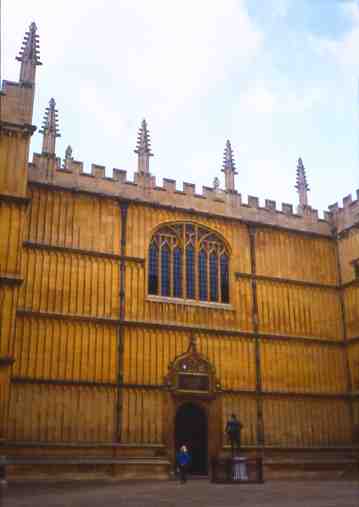
Opened to the public on November 8, 1602, the Old Bodleian (photo), centerpiece of a library complex that today comprises the original institution and about a dozen other buildings, rises like a golden stone surprise from the pavement of the Old Schools Quad.

At 404 years old, the Bodleian is a relative teenager in Oxford's family of teaching institutions. An industrial city now surrounds Oxford's ancient core, but you can spend days discovering the old city's university heart, walking its cobbles, resting in its chapels, stumbling upon its myriad, enchanting Gothic quadrangles.

By 1602, when the Bodleian opened its doors, Oxford had already seen nearly 600 years of educational pursuit, teaching having existed here in some form since the 11th century. My hotel room looked into a courtyard of Merton College, founded in 1254 and one of the oldest of Oxford University's 39 official colleges.

I began my walking tour of Oxford, the English-speaking world's oldest university, by following cobblestoned Merton Street, which delivered me to one of Merton College's green lawns. I sat, soaking up the scarce spring sun of a nearly cloudless day, and contemplated the seven and a half centuries of history that the stone facades around me had witnessed.

I walked on to New College -- new in 1379 -- then poked about the yards and gates and courtyards and grand quadrangles of 13th-century University College, The Queen's College (1341), Magdalen (1448), Brasenose (1509), and Christ Church, founded in 1524 as Cardinal's College by Cardinal Wolsey, appropriated by Henry VIII in 1529 after Wolsey's tumble from power, then refounded by the much-married monarch as Christ Church in 1546.

Gothic spires everywhere. Students rushing alone down narrow alleys and main streets, or walking in pairs or groups, slowly, discussing topics I imagined were over my head. And bicycles everywhere. Old, seriously-fendered vehicles with fat tires and wicker baskets strapped to handlebars and little chinking bells and thick coats of paint upon paint in hardware store colors of ochre and cream and russet and navy blue.

As I meandered through the old city's university core, threading the labyrinth of majestic spaces, I felt the power of the place and its near- thousand years of history, architecture, intrigue, exploration, enlightenment.

Four-century-old Bodleian is a beauty, but in Oxford, just a baby.

www.LoriHein.com

November 21, 2005

Polperro's Harvest of the Sea


(A version of this story was first posted in November 2004.)

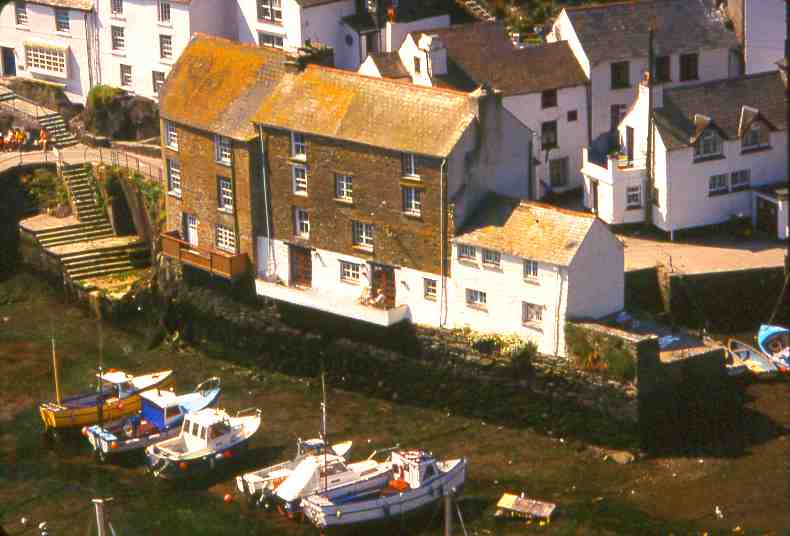
Music helped knit our family into the life of Polperro (photo), an ancient town on Cornwall's rugged coast. We’d rented a flat at Brent House, high on Talland Hill above the harbor and the English Channel. The Polperro Fishermen’s Choir was due to sing at the Polperro Methodist Church at 6 p.m. one evening. I pried the family from other pursuits, and we made our way down the steep hill into the village. A young man in black clothes carrying a briefcase ran past us. He greeted us with a smile, then continued his headlong rush. “Think he’s the minister?” I asked Mike. “He looks like he’s late for church...”

He wasn’t the minister, but he was a member of the choir, and he greeted us again in the church’s small forecourt where he stood with the 22 other choir members, all with portfolios or briefcases containing their sheet music. “Go right in!” said a charming lady at the gate. “Hear the fishermen sing! Although they’re not all fishermen," she admitted with a wink.

You could tell which ones were by their sun-reddened faces and their sturdy, muscular bodies. They were a fit, handsome group. Most had hair whitened by wisdom, sea and salt, but some were younger, with, God willing, decades left to fish and sing. We sat upstairs near the choir. The service was a centerpiece of Polperro’s Harvest of the Sea, and the choir had come to sing for God's blessings on all who made their living from the water.

The church was clad in nautical attire. Fishnets full of paper fish cut-outs hung from the balconies. Fat sea ropes festooned the preacher’s pulpit, above which towered a fishing boat’s main mast. Seashells lined the altar, and lifejackets, buoys and a gleaming sextant in a hand-crafted box sat as offerings. The Polperro Fishermen sang eight glorious hymns, most a cappella. They were dressed in black pullovers reminiscent of the roll-necked jerseys that women once knitted for their seagoing men, and their 23 voices filled the church with powerful songs of praise and faith.

Their music at once transported and tethered you. Transported you to a spiritual place where ties bind men to God and to each other. Tethered you to the often harsh realities of Cornish fishing village life. They sang of God as anchor. Of rest, respite, rescue and safe harbors. Their stances and voices were strong and steady, like a good boat’s course. Some sang with eyes closed and arms locked over chests. Their straightforward reverence filled the church in forceful, deeply moving swells.

We put some American dollars in the offertory pouch that one of the choir members had circulated around the upstairs pews. When the last hymn was sung and the benediction delivered, we made our way downstairs to file out with the rest of the congregation. A lady we’d chatted with earlier had gathered a few friends, and they waited for us at the bottom of the stairs. “These people came all the way from Boston!” she told them. The ladies grasped our hands and told us how thrilled they were to have us join their worship and celebration.

Then a voice called out, “Now! To the quay!” The church emptied, and we made our way with the throng of townspeople to the harbor, where the Harvest of the Sea celebration would continue into the night.

LoriHein.com

July 09, 2005

London: Another finest hour


You robbed them of the only power they have: the power to terrorize. They didn't shut you down, not even for a day. They're hiding, and you're back on your streets, going proudly about the business of living, stripping more of their power away with every step you take. Bravo, Britain.

June 13, 2005

So where's the eclipse, Einstein?


In this month’s Smithsonian, an article by Richard Panek tells about the year that Albert Einstein got on a roll and stayed there, revolutionizing science. In 1905, Einstein made a series of dazzling discoveries and set down theories and mathematical equations that tipped science on its ear and gave birth to modern physics. To celebrate the centennial of Einstein’ s most excellent year, physics organizations around the globe have dubbed 2005 the “World Year of Physics,” and Einstein and his body of work are getting lots of attention.

It was in 1905 that Einstein noted, in the little equation E=mc squared, that at the atomic level energy and matter can be transposable, an observation that gave birth to the nuclear age. The same year, with his theory of special relativity, the quiet scientist made the world rethink notions about the relationship between space and time held since Copernicus and Galileo had dared share educated guesses in the 16th and 17th centuries. True derring-do back then when the world was dealing with the shock of not being the center of the universe and a person could get himself killed for talking science.

But, according to Panek, it was in 1907 that Einstein began to noodle with special relativity, adding another dimension to it. Special relativity deals only with a resting body and a body moving at a constant velocity. Einstein’s brain seized on the challenge of explaining the relationship between a resting body and a body whose movement accelerates. He took Newton’s laws of gravity and rethought them, postulating that acceleration and gravity are the same force. It took Einstein eight years to develop the mathematical sentences for his new theory of general relativity. Once he had the math, he needed a solar eclipse to prove his theory, as the eclipse would enable observation of gravity’s effect on light, key to his hypothesis. A solar eclipse on May 29, 1919 did the trick, and Einstein changed human thought, became a household word and made science synonymous with a mustachioed man with lucid, popping eyes and white, wild hair.

Good thing proof of Einstein’s Theory of General Relativity didn’t hinge on the solar eclipse of 1999. We might still think apples falling from trees tell us everything we need to know about gravity.

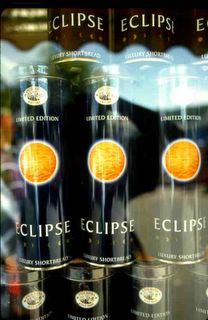
We were in Cornwall, England, enjoying a family vacation. In planning our trip, I’d been clueless about the total eclipse of the sun due to be visible over Cornwall on August 11, 1999. As soon as we landed in England, we were bombarded by eclipse things – posters, radio chat, TV broadcasts, bumper stickers, street conversation, t-shirts, tins of “Eclipse” cookies arrayed in eye-catching store window displays (above). Anticipation of the event eclipsed nearly everything else.

We drove to Cornwall, and frenzy heightened. Signs on the motorways read, “Solar Eclipse – Expect long delays on route to the South-West 6-11 August.” Cars heading to Cornwall clogged the roads.

Once in Cornwall, we stocked up on groceries at the Safeway in Liskeard before making our way through seaside Looe to Polperro, where we’d rented an apartment. Safeway cashiers handed out flyers detailing plans the supermarket had made to accommodate the community’s needs when the expected “over a million visitors to the area” descended at eclipse time. A sign posted at a Tesco food shop near Penzance informed shoppers that the store would close “for 2 hours on August 11 from 11-1 pm in order that our staff may enjoy the eclipse.”

At the Bronze Age Duloe Stone Circle, a homemade sign nailed to a gate announced a special eclipse gathering to be held at the Neolithic site (robes optional). At Duloe, Mike concentrated on negotiating the minefield of mutton manure, Adam put his sweatshirt hood up and ran around pretending to be a Druid, and Dana chased sheep. I read the gravestones in the nearby 14th-century church cemetery, including one honoring a 20-year-old boy who “Unfortunately Drown’ed in The Shallow Pool and was Swallowed by The Deep.”

We left Europe on August 8. Back home, I monitored the eclipse reports on August 11. The eclipse was a bit of a bust. National Public Radio announced that “cloud cover made the eclipse invisible” to the millions who’d gathered in Cornwall to view it. (Click here for Martin J. Powell ‘s great account of what it was like to not see the eclipse.)

When I heard that clouds had totaled the eclipse and all those folks we’d met and seen had seen nothing, I figured they’d handled the celestial raw deal with characteristic stiff upper lip and good humor. “Well, then, that’s that, isn’t it?” I imagined them saying as they smoothed out their eclipse t-shirts, popped another eclipse biscuit into their mouths and loaded their folding chairs into the boots of their cars.

What would Einstein have done?


November 16, 2004

Polperro Fishermen's Choir: Songs of Praise

The weather here in New England has turned. No longer on the summer-fall cusp, we teeter now between fall and winter. ‘Tis the season to argue with one’s teenagers about wearing coats. ‘Tis also the season for harvests and holidays, music and gatherings, peace and comfort found in a circle of family and friends. This time of year, my taste in music turns from secular to sacred, and I spend more of my piano-playing time with hymns of praise, hopeful carols, and rich, liturgical choral works like Franck’s Panus Angelicus.

When I was a student in Paris, negotiating the city with little money in my pocket, living with a family who hosted me only because they earned a stipend, trying to communicate in a place with little patience for the imperfect, I found solace in churches and cathedrals, and I’d often duck off the street, sit in a dark pew, and let the notes of a practicing choir or organist soothe and renew me. Ever since, I’ve savored the depth and dimension that music brings to the travel experience.

Music helped knit our family into the life of
Polperro, an ancient Cornish fishing village with a harbor tucked snug behind high, green headlands. We’d rented a flat at Brent House, high on Talland Hill above the harbor and the English Channel. The Polperro Fishermen’s Choir was due to sing at the Polperro Methodist Church at 6 p.m. one evening. I pried the family from other pursuits, and we made our way down the steep hill into the village. A young man in black clothes and carrying a briefcase ran past us. He greeted us with a smile, then continued his headlong rush. “Think he’s the minister?” I asked Mike. “He looks like he’s late for church...”

He wasn’t the minister, but he was a member of the choir, and he greeted us again in the church’s small forecourt where he stood with the 22 other choir members, all with portfolios or briefcases containing their sheet music. “Go right in!” said a charming lady at the gate. “Hear the fishermen sing (although they’re not all fishermen),” she admitted winkingly. You could tell which ones were by their sun-reddened faces and their sturdy, muscular bodies. They were a fit, handsome group. Most had hair whitened by wisdom, sea and salt, but some were younger, with, God willing, decades left to fish and sing.

We sat upstairs, near the choir. The service was a centerpiece of Polperro’s Harvest of the Sea, and the choir had come to sing supplications to God to protect those who made their living from the sea and risked death to harvest its bounty. The church was clad in nautical attire. Fishnets full of paper fish cut-outs hung from the balconies. Fat sea ropes festooned the preacher’s pulpit, above which towered a fishing boat’s main mast. Seashells lined the altar, and lifejackets, buoys and a gleaming sextant in a hand-crafted box sat as offerings.

The Polperro Fishermen sang eight glorious hymns, most a cappella. Dressed in black roll-necked shirts reminiscent of the roll-necked jerseys that wives and daughters knit for their men who go to sea, the 23 voices filled the church with powerful songs of praise and faith. Their music at once transported and tethered you. Transported you to a spiritual place where ties bind men to God and to each other. Tethered you to the often harsh realities of Cornish fishing village life. They sang of God as anchor. Of rest, respite, rescue and safe harbors. Their stances and voices were strong and steady, like a good boat’s course. Some sang with eyes closed and arms locked over chests. Their straightforward reverence filled the church in forceful, deeply moving swells.

We put some American dollars in the offertory pouch that one of the choir members had circulated around the upstairs pews. When the last hymn was sung, and the benediction delivered, we made our way downstairs to file out with the rest of the congregation. A lady we’d chatted with earlier had gathered a few friends, and they waited for us at the bottom of the stairs. “These people came all the way from Boston!” she told them. The ladies grasped our hands and told us they were thrilled to see us. Then a voice called out, “Now! To the quay!” The church emptied, and we made our way to the harbor, where the Harvest of the Sea celebration would continue.


Polperro Fishermen's Choir


The Polperro Fishermen's Choir sings from the loft of Polperro's Methodist church