Showing posts with label US-WY. Show all posts

July 03, 2008

Uncrowded America: Bikers, fish and one old grouch

We're about to take off for the Fourth of July weekend. We're spending it, as we always do, at our place in New Hampshire's Monadnock region. While I can't wait to get there and crack a beer, I'm not looking forward to being on the highway for the next four hours with thousands of other people. Four-dollar a gallon gas notwithstanding, the roads will be mighty crowded this afternoon.

Makes me nostalgic for some of the uncrowded places I've seen in my journeys around America.

Like Sand Cut, Florida, the "Speck Capital of the World." This little burg sits on Lake Okeechobee, the best spot in Florida to fish for speck, also known as speckled perch or black crappie. Sand Cut gets a lot of fishing visitors but has a permanent population of fewer than 10 souls, including the "old grouch" who merits mention on the hamlet's welcome sign.


Then there's Aladdin, Wyoming, population 15. When the kids and I drove through it, we stopped at the Aladdin General Store, where dozens of bikers on their way to Bike Week in nearby Sturgis, South Dakota, were hanging out on the store's porch chugging Cokes and smoking Marlboros. I sat on the porch and marveled that, for those few rest stop minutes, we and the bikers had swelled Aladdin's population to triple its normal size.

November 07, 2007

Sundance rodeo

Sundance, Wyoming wrapped its cowboy tradition around us within an hour of arrival. We sat back on bleachers and watched the whole town turn out to see local seat-of-the-pants toughness in action at the Crook County Fair.

Some of the toughest pants belonged to grammar school kids in full chaps and cowboy hats who tore around barrels and poles so fast I wondered what it must be like to be their mothers, watching their babies streak around the dusty arena at full gallop, cutting edges and corners closer than a buzz cut. We got dirt kicked in our eyes every few minutes, and loved every granule.

Outside the arena fence, pickups and horse trailers sat in the grass, and people led, fed, and groomed their horses. It was kids’ rodeo night, with both juniors and seniors competitions, and grade schoolers to teengers waited outside the fence, controlling varying amounts of nervous energy.

Inside the arena fence it was take-no-prisoners rodeo.

And, between outside and inside, the rodeo queen reigned from the fence at the chute that fed the riders into the ring. The queen was about 17, and she wore glasses, jet black cowboy hat and jeans, and a cobalt blue shirt of glittering sequins that dazzled and jumped like it was alive. Everyone around was dusty, but the queen sparkled.

I took a picture of her, from behind. She sat on the fence facing left, watching the next rider tuck her nervousness up under her hat and get ready to enter the ring.

The rodeo kids were amazing riders. Sharp-turning and lightning fast. Kids with names like Tess and Cody earned blue and purple ribbons, and their parents displayed them on the side mirrors of their pickups or lined them along their dropped truck bed tailgates next to the horse grooming brushes.

"Look at that lil’ cowboy!" exclaimed the announcer, as some tiny guy in jeans and boots and hat (how do they stay on at that speed?) raced tight around obstacles and thundered across the arena. Townspeople here know what kind of cowboy a kid is by the time he’s 10.

Above us, on the bleachers’ top two rungs, sat a group of lean, fit teenagers, all of them, boys and girls alike, with self-assured mountain good looks. "You ride that horse, girl!" They whooped and cheered for their barrel-racing friends the way other high school kids scream for the kids who make touchdowns and slam dunks and speed records in the mile. The harder and faster the riding, the tighter the corners, the louder the hoof-pounding, the dustier the ring, the greater the appreciation and approval from the rider’s peers.

Adam preferred the Sundance Motor Inn’s cable TV to rodeo, but Dana was utterly enthralled by this magical place where people lived and breathed riding and ranching and rodeo as a matter of course, threads in the fabric of their everyday lives. She saw past the spectacle of the Crook County Fair and realized in a hoofbeat that the people in this town – the kids and teenagers, moms and dads, aunts and uncles, grandmas and grandpas – lived a life centered on land and animals, the outdoors, hard work and hard play. They lived and worked in jeans and cowboy hats. Where we live, people gather for baseball and soccer games. Sundancers gather for rodeo.

Dana spoke barely a word while we sat on those bleachers. I could see her thoughts. I could see her eyes take in everything, every detail her senses allowed her to capture. I watched her mind catalogue Sundance, Wyoming as a dream town, the greatest place on earth to live.

Proof positive of the town’s magic came when the loudspeaker crackled and the rodeo announcer broadcast the news that there’d be a giant cake to celebrate 4-H’s 100th birthday. Everyone was invited to come back to the big exhibition barn where the cake would be cut, "after Karaoke Madness." Surely, heaven must be like Sundance. Horses everywhere and a cake big enough to feed the whole town.

I went out at 6:30 the next morning and ran the neat, tree-lined streets of tiny Sundance and ended up back at the fairgrounds, which sat next to the Crook County Regional School, "Home of the Bulldogs." The yellow school buses that had been parked since June still had last school year’s "Who Let The Dogs Out" and "Go Dogs Go" written in white paint all over their windows.

I ran behind the livestock barn where, the night before, we’d taken in the exhibitions and seen prize-winning pigs and cows and champion sheep, wrapped like royalty in little purple coats.

In rose-colored post-dawn, the scene was different. No flash or showmanship, just love, pride and hard work. A dozen or so of the ranchers and farmers who owned these show animals were in the barn, tending to their livestock. Feeding, washing, grooming, patting, talking, whispering. A family gathered around its goat, stroking it.

Out back, a lanky teenage boy with long, tousled brown hair nuzzled, soothed and said good morning to his black cow. He held the animal’s ears in his hands and rested his chin on the cow’s forehead. I left Sundance with this scene of love and deep contentment in my head.

excerpted from Ribbons of Highway: A Mother-Child Journey Across America


June 17, 2006

The tragedy of Little Bighorn


This month marks the 130th anniversary of the Battle of Little Bighorn, when Indians won the day but sealed their fate. Little Bighorn National Monument is an eerie place, and unless you listen carefully to all the ghosts that haunt Last Stand Hill, it's too easy to hear only the white man's version of this bloody bit of American history.

I write about a visit to Little Bighorn in my book:


Big Horn County was brown, dry, rolling. The Crow Reservation sits on the prairie. At Crow Agency, the reservation’s main town, Indians gathered for a festival in a green park off the highway, teepees pitched in the park and pickups lining the perimeter.

When we got to Little Bighorn, I thought of the Crow just down the road, and how they might feel about this national monument. We bought food at the Kentucky Fried Chicken outside the entrance, and I wondered what the young Sioux behind the counter thought of the site that brought in tourists who bought mashed potatoes and popcorn chicken.

I’d seen Little Bighorn many years before from the air, on a flight to somewhere in California. I’d seen Custer’s whole hill, and could contemplate the approach, the ambush, the surprise and the death, from 25,000 feet. The sky had been cloudless, as if God had said, “Here, look down now. Look down on a place where men killed each other for reasons even I don’t understand.”

William Faulkner said, “The past is not dead…it is not even past.” Last Stand Hill marks the spots where Custer and some forty of the approximately two hundred and forty Seventh Cavalry soldiers who died on June 25, 1876 fell. Directly across from Last Stand Hill, on the other side of a narrow road, we watched men work, bare-chested in the blast furnace heat, on the Native American monument that will be connected to Last Stand Hill by a rift, a slit, a gash – a physical feature announcing that “a weeping wound or cut exists.”

On June 25, 1988, American Indians placed a plaque at the foot of the granite obelisk commemorating Custer and his cavalrymen. Now in the Visitor Center, the plaque holds these words by G. Magpie, Cheyenne: “In honor of our Indian Patriots who fought and defeated the U.S. Calvary (sic) In order to save our women and children from mass murder. In doing so, preserving our rights to our Homelands, Treaties, and Sovereignty.” At the base of the plaque were items left in tribute: coins, ribbons, flags, and notes saying, “Thank you for honoring the Sioux.”

Sioux, Cheyenne and Arapaho fought that day. After the battle, surviving Indians were rounded up and incarcerated, and some who had witnessed the Battle of Little Bighorn drew pictures of what they had seen. Called ledger drawings, they were drawn on the only paper available in military prison camp – ledger paper from the camp commissary. The Marquis and Colter ledger drawing collections hung on the back wall of a Visitor Center room with sweeping views of the battlefield and Last Stand Hill. I turned from the wall to the windows, from the windows back to the wall. Looking at the drawings, – some naïve, some masterfully rendered, all the product of eye, hand, soul and heart – I realized Last Stand was a double-entendre. Yes, it was certainly Custer’s, but I was looking at eyewitness accounts of a victory by the victors, who were then swept away to draw pictures on paper that white men used to take stock and make an accurate and precise accounting of things.


from Ribbons of Highway: A Mother-Child Journey Across America. To order your copy or download the e-book, click here. Your purchase will help me keep this blog ad-free. If you download the e-book ($8.95) and then find that you'd like a signed hard copy, I'm happy to offer a discount and pay the shipping. Send an e-mail with "Ribbons e-book" in the subject line and I'll shoot you the details.


LoriHein.com

January 05, 2006

The bear and the seven Sioux sisters


The Black Hills, Sioux homeland stolen from its stewards when white men found gold, spill from South Dakota into Wyoming and offer geologic marvels like Devil’s Tower.

Like many visitors to Devil’s Tower, we stayed in Sundance, Wyoming (where we were dazzled by hard-charging teenage rodeo riders at the annual Crook County Fair). You can also nab a bed in nearby Hulett or camp at the Devil’s Tower KOA, down the road from a feverishly busy prairie dog community.

An excerpt from Ribbons of Highway: A Mother-Child Journey Across America, Chapter 10: OPEN SPACES: Northeast Wyoming, the Dakotas:


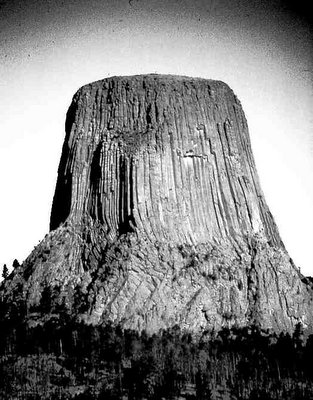
To attract tourists, white men gave an astonishing east Wyoming monolith, with a flat top immense enough to host the mother ship of Spielberg’s aliens, the name Devil’s Tower. The Sioux call the rock column Bear Lodge.

In Sioux legend, this pillar of land thrust itself from the earth in time to lift seven frightened maidens beyond reach of a hungry bear. The great earth column rose, and carried the maidens to safety. The bear clawed at the monolith as it rose, and the long, vertical claw marks now run from Bear Lodge’s flat top to its wooded bottom, and around its entire circumference.

The Sioux also explain the genesis of a piece of night sky through the Bear Lodge legend. The column of land that held the seven frightened maidens rose higher and kept climbing until the maidens were delivered to the heavens, where they became the constellation Pleiades – the Seven Sisters.

The crowds hadn’t yet rolled in when we made our one mile-and-change hike around the base of Devil’s Tower through a landscape covered with boulders and rock pillars heaved over eons from the tower’s sides to the Ponderosa pine forest below. Six climbers had secured permits to pass beyond the boulder field at the tower’s base and try for the summit, and they were part of this singular scene. There was a moment in the sylvan forest that hugged the green, lichen-tinged monolith when I looked on two worlds at once.

Up and to my left, I watched a tiny figure, clad in and hanging from new technology, inch his way up the tower’s vertical wall. I looked down and to the right, and saw a tree hung with Native American prayer cloths and prayer bundles filled with offerings of cedar, sweet grasses, and sacred tobacco. On my left, people said, “I’m human. I respect but can conquer you.” On my right, people said, “I’m human. I respect and worship you.”


LoriHein.com